PKM Guide: The Art of Organizing Scattered Ideas
Build a personal knowledge management system that turns scattered ideas into actionable knowledge. Frameworks, methods, and tips.
Knowledge workers waste an average of 9.3 hours every week searching for information they already have. That is more than a full workday lost — not to creating, thinking, or deciding — but to hunting through cluttered folders, scattered bookmarks, and half-forgotten notes.
If you have ever had a brilliant idea vanish before you could act on it, or spent 20 minutes looking for a link you saved "somewhere," you already understand the problem. Your brain generates ideas constantly. It just was never designed to store them.
Personal knowledge management (PKM) is the practice of capturing, organizing, and retrieving your own knowledge so that scattered thoughts become a structured, searchable system you can actually use. This guide walks you through the science behind why ideas scatter, the proven frameworks for taming them, and a step-by-step process for building a PKM system that works for your life — not against it.
Here is what you will learn:
- Why you forget most of what you learn unless you come back to it — and what to do about it
- Four battle-tested PKM frameworks and when to use each one
- A practical 5-step process for building your own system from scratch
- The single weekly habit that separates thriving PKM systems from abandoned ones

Table of Contents
- What Is Personal Knowledge Management (and Why Should You Care)?
- The Science Behind Scattered Ideas
- Four Proven PKM Frameworks Compared
- Building Your PKM System Step by Step
- Choosing the Right PKM Tools in 2026
- Common PKM Mistakes (and How to Avoid Them)
- The Weekly Review: The Habit That Makes Everything Work
- Frequently Asked Questions
What Is Personal Knowledge Management (and Why Should You Care)?
Personal knowledge management is the systematic process of collecting, classifying, storing, retrieving, and sharing the knowledge you encounter in daily life. It is not just about saving links or highlighting passages. It is about closing the gap between what you consume and what you actually use.
Think of every article you have read, every podcast you have listened to, every meeting you have attended. How much of that information can you recall right now? Without a deliberate system, most of what we take in fades within days.
That statistic is not a failure of intelligence. It is a feature of human biology. Your brain is an extraordinary idea-generation machine, but it is a terrible storage device. PKM exists to solve that mismatch.
The Real Cost of Disorganized Knowledge
The numbers paint a stark picture. A recent productivity study found that 60% of work time is spent on "work about work" — searching for information, switching between applications, tracking down decisions, and managing communications. Only 40% goes toward the skilled, strategic work people were actually hired to do.
For individuals, the cost is equally high. Every scattered idea represents a missed connection. Every forgotten insight is a decision made with incomplete information. Over months and years, that adds up to slower learning, weaker decisions, and creative projects that never get off the ground.
A well-built personal knowledge management system reverses this pattern. It becomes an external thinking partner — a place where your best ideas wait patiently until you need them.
The Science Behind Scattered Ideas
Understanding why ideas scatter is the first step toward keeping them together. Three forces work against you, and none of them are your fault.
The Forgetting Curve
In 1885, German psychologist Hermann Ebbinghaus conducted a series of experiments that revealed the now-famous forgetting curve. He memorized lists of nonsense syllables and measured how much time relearning them saved after different delays. The savings fell fast at first:
- After 20 minutes, relearning took 58% less time than the first learning
- After 1 hour, 44% less
- After 1 day, 34% less
- After 6 days, 25% less, and after a month, 21%
A 2015 replication by Murre and Dros found a very similar curve. The exact numbers describe one person learning nonsense syllables, not how much of a lecture you will keep, but the shape carries over: forgetting is fastest right after learning and slows down after that.
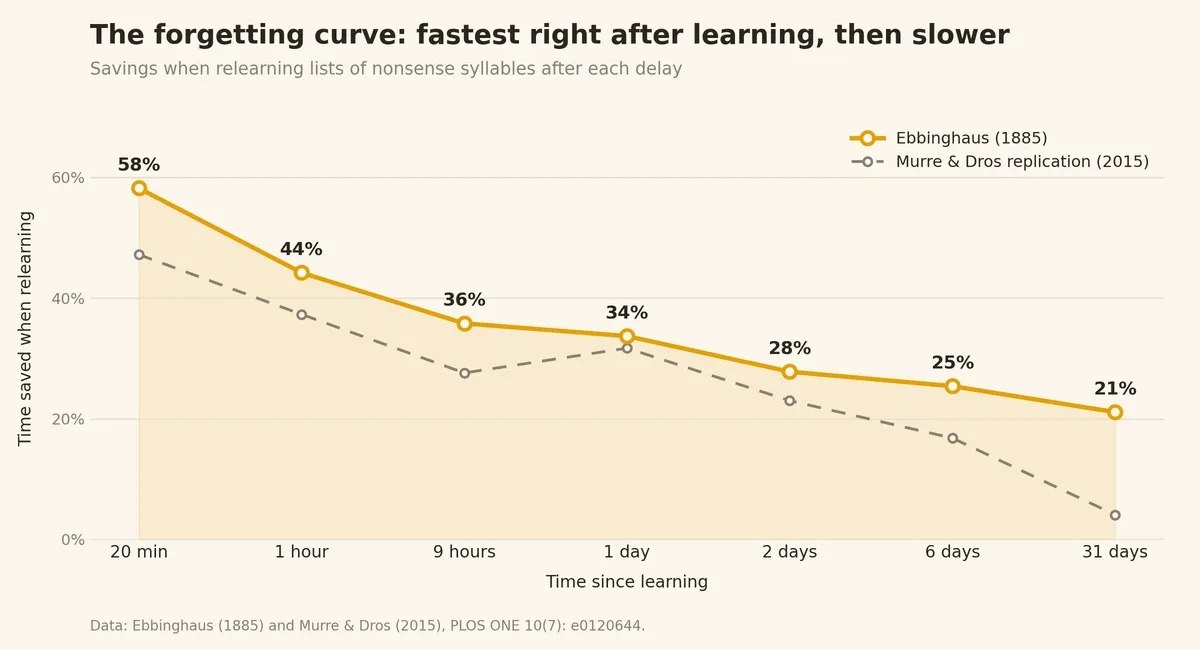
This curve is not a defect. It is your brain's way of prioritizing. Information that is not reinforced gets deprioritized to make room for what seems more immediately relevant. The problem is that "immediately relevant" and "genuinely important" are not always the same thing.
Cognitive Overload
Modern knowledge workers face a second challenge: the sheer volume of incoming information. We process emails, messages, articles, videos, podcasts, meetings, and social media — often simultaneously. Research on information overload confirms that when the brain's working memory is saturated, its ability to process, connect, and store new ideas drops sharply.
You are not failing to organize your ideas. Your brain is simply overwhelmed by the quantity it is being asked to handle.
The Storage Mismatch
Here is the fundamental insight that makes PKM necessary: your mind is for having ideas, not for holding them. The human brain excels at pattern recognition, creative association, and generating novel thoughts. It struggles with reliable, long-term storage and precise retrieval.
A personal knowledge management system does not replace your brain. It complements it. By offloading storage and retrieval to an external system, you free your mind to do what it does best — think.
Four Proven PKM Frameworks Compared
Not every brain works the same way, so not every personal knowledge management framework suits every person. Four dominant methodologies have emerged, each optimized for a different type of thinker.
PARA: Projects First
PARA stands for Projects, Areas, Resources, and Archives. It organizes everything around actionability.
- Projects: Current tasks with a defined end goal (e.g., "Launch newsletter," "Write research paper")
- Areas: Ongoing responsibilities with no end date (e.g., "Health," "Career development," "Finances")
- Resources: Topics of ongoing interest (e.g., "Machine learning," "Cooking techniques")
- Archives: Completed or inactive items from the above three categories
PARA works best for action-oriented people who want their knowledge system to directly feed their work. Notes are organized by where they are most useful, not by what topic they belong to.
Zettelkasten: Connections First
The Zettelkasten method (German for "slip box") was developed by the sociologist Niklas Luhmann, who used it for nearly 600 publications, including more than 40 books. The system is built on three note types:
- Fleeting notes: Quick, temporary captures of ideas
- Literature notes: Key points from what you read, in your own words
- Permanent notes: Fully developed ideas, each on a single card, linked to related notes
The power of Zettelkasten lies in its linking structure. Each note connects to others, creating a network of ideas that grows smarter as it expands. It is designed for discovery — you follow links between notes and stumble on connections you never planned.
CODE: Creative Output
CODE stands for Capture, Organize, Distill, Express. It is a workflow framework designed to turn raw information into creative output.
- Capture: Save only what resonates — insights, ideas, quotes, and data that feel genuinely noteworthy
- Organize: File each item where it will be most useful, typically by active project
- Distill: Extract the essential message from each note using progressive summarization (more on this below)
- Express: Turn your distilled knowledge into tangible output — articles, presentations, products, decisions
CODE is ideal for creators, writers, and anyone who wants their PKM system to produce something rather than just store information.
GTD: Task Execution
Getting Things Done (GTD) is technically a productivity system, but its capture-and-process methodology overlaps heavily with PKM. The core principle is simple: get everything out of your head and into a trusted system, then process it with clear next actions.
GTD works best when your primary challenge is not connecting ideas but managing the volume of tasks, commitments, and information flowing at you daily.
Which Framework Should You Choose?
| Framework | Best For | Core Strength | Weakness |
|---|---|---|---|
| PARA | Action-oriented workers | Organized by usefulness | Weaker at idea discovery |
| Zettelkasten | Researchers, writers, deep thinkers | Emergent connections | Steeper learning curve |
| CODE | Creators and content producers | Turns input into output | Requires consistent expression |
| GTD | Busy professionals, managers | Clears mental clutter | Less focused on knowledge growth |

The most effective personal knowledge management practitioners often combine elements from multiple frameworks. You might use PARA for organization, Zettelkasten for linking ideas, and CODE as your daily workflow. There is no single right answer — only the right fit for how your brain works.
Building Your PKM System Step by Step

Theory is helpful. Practice is essential. Here is a concrete, five-step process for building a personal knowledge management system that actually works.
Step 1: Capture — The 10-Second Rule
The single most common reason people fail at PKM is not poor organization. It is inconsistent capture. If writing down an idea takes more than 10 seconds, you will not do it reliably.
Your capture system must be frictionless:
- Always accessible (phone, computer, or a physical notebook you carry everywhere)
- Fast to open (one tap or one click)
- Flexible enough for text, images, links, and voice notes
Do not worry about formatting, categorizing, or filing at this stage. The only goal is to get the idea out of your head and into a trusted location before your brain discards it. You can organize later.
Practical tip: Create a single "inbox" — one designated place where all raw captures land. Everything goes here first. No exceptions.
Step 2: Organize — Give Every Note a Home
Once a week (or daily, if you capture a lot), process your inbox. For each item, ask one question: "Where will this be most useful?"
Using the PARA framework as a baseline:
- Does it relate to an active project? File it there.
- Does it support an ongoing area of responsibility? Put it in that area.
- Is it a useful resource for a topic you care about? Save it under that topic.
- Is it none of the above? Either archive it or delete it.
The goal is not perfection. It is making each note findable when you need it. A simple, consistent structure beats an elaborate one you abandon after two weeks.
Step 3: Connect — Build the Web
This is where PKM transforms from a filing cabinet into a thinking tool. After organizing a note, spend 30 seconds asking:
- What other notes does this relate to?
- Does this support, contradict, or extend an existing idea?
- Could this be useful in a current project?
Create links between related notes. Over time, your system develops a network of connections that mirrors how your brain actually thinks — through association, not hierarchy.
A study on networked note-taking found that linked knowledge bases become more valuable with every new addition, because each note creates potential new connections with everything already in the system. The growth is exponential, not linear.
Step 4: Distill — Progressive Summarization
Not every note deserves the same level of attention. Progressive summarization is a technique for distilling notes in layers, doing only as much work as each piece of information deserves.
- Layer 1: The original captured text
- Layer 2: Bold the most important passages
- Layer 3: Highlight the key sentences within the bolded text
- Layer 4: Write a brief executive summary at the top of the note
You do not process every note to Layer 4. Most stay at Layer 1 or 2. Only the notes you return to repeatedly get progressively distilled. This is efficient because it focuses your energy where it matters most — on the ideas you actually use.
Step 5: Express — Use What You Know
A PKM system that you never draw from is just an organized graveyard. The final step is to express — turn captured knowledge into tangible output.
This could mean:
- Writing an article using linked notes as your research base
- Preparing a presentation by pulling distilled insights from multiple sources
- Making a better decision by reviewing everything you have collected on a topic
- Teaching someone else what you have learned
Expression is not optional. It is the step that closes the loop and makes the entire personal knowledge management system worthwhile. Every time you use your PKM system to create something, you reinforce the habit and discover gaps in your knowledge that drive better future capturing.
For a deeper look at how to integrate personal knowledge management into your productivity workflow, see our productivity and knowledge workflow guide.
Choosing the Right PKM Tools in 2026
The PKM tool landscape in 2026 has matured significantly, with the global personal knowledge management software market reaching $2.45 billion in 2024 and growing rapidly. But choosing a tool is less important than choosing a workflow. The best system is the one you will actually use consistently.
Here are the main categories to consider:
Local-First Markdown Editors
These tools store your notes as plain text files on your own device. You own your data completely, and your notes remain accessible even if the software disappears. They typically support bidirectional linking, graph visualization of note connections, and extensive plugin ecosystems.
Best for: Privacy-conscious users, researchers, and people who want full data ownership and long-term durability.
Cloud-Based All-in-One Workspaces
These platforms combine notes, databases, project management, and collaboration in a single cloud-based environment. They offer powerful relational databases, templates, and team features.
Best for: Teams, flexible workers who want notes and task management in one place, and people who value collaboration features.
Outliner-First Tools
These organize everything as nested outlines with block-level referencing. Every bullet point is independently linkable, queryable, and reusable. They are particularly strong for daily journaling, task management, and rapid idea capture.
Best for: Structured thinkers, daily journalers, and people who think in hierarchical outlines.
AI-Native Knowledge Platforms
The newest category uses artificial intelligence to automate capture, suggest connections, and surface relevant notes based on context. 38% of knowledge management teams already use AI to recommend content, and this number is rising fast. These tools reduce the manual maintenance burden that causes many PKM systems to be abandoned.
Best for: People who want minimal manual organization and are comfortable with AI-assisted workflows.
What to Prioritize When Choosing
Regardless of category, look for these non-negotiable features:
- Low capture friction — Getting an idea in should take seconds, not minutes
- Reliable search — You should find any note within 10 seconds
- Linking capability — The ability to connect notes to each other
- Export options — Never let your knowledge become trapped in one platform
- Cross-device access — Your PKM system is useless if it is not with you when ideas strike
Pro tip from Nottut: The biggest mistake is spending weeks researching tools instead of starting. Pick one that meets the five criteria above, commit to it for 30 days, and only switch if it creates genuine friction in your workflow.
Common PKM Mistakes (and How to Avoid Them)
Building a PKM system is simple. Maintaining one is where most people stumble. Here are the six most common mistakes and their fixes.
1. Hoarding Everything
When people discover PKM, they tend to save everything — every article, every tweet, every video. Within weeks, their system is a cluttered mess that feels exactly like the problem they were trying to solve.
The fix: Be ruthlessly selective. Before saving anything, ask: "Does this relate to a current project or a genuine ongoing interest?" If the answer is no, let it go. A lean system with 100 high-quality notes beats a bloated one with 10,000 unread clips.
2. Over-Linking Notes
Bidirectional linking is a powerful feature, but it is easy to overuse. Linking everything to everything creates noise, not signal. When every note connects to dozens of others, the links stop being meaningful.
The fix: Only create a link when there is a genuine conceptual relationship between two notes. Ask yourself: "Would following this link actually help me think about either topic?" If not, skip it.
3. Building Overly Complex Systems
Fancy templates, elaborate tagging hierarchies, custom databases with 15 properties — these feel productive to build but are exhausting to maintain. Complex systems become a source of anxiety instead of calm.
The fix: Start with the simplest possible structure. A single inbox, a basic folder system, and one weekly review session. Add complexity only when your simple system feels genuinely limiting — not when you are bored and want to tinker.
4. Neglecting the Review Habit
A PKM system without regular review is a knowledge graveyard. Notes pile up in the inbox, connections go unmade, and the system slowly becomes irrelevant.
The fix: Schedule a non-negotiable weekly review. Even 15 minutes is enough. This single habit is what separates systems that thrive from systems that die.
5. Confusing Collection with Understanding
Saving an article is not the same as understanding it. Highlighting a passage is not the same as integrating the idea into your thinking. Many people build impressive-looking libraries of content they have never actually engaged with.
The fix: After capturing a note, add at least one sentence in your own words explaining why it matters. This tiny step forces your brain to process the information rather than just file it.
6. Switching Tools Too Often
Every few months, a new PKM app launches with exciting features. Migrating your system becomes a project in itself, and you spend more time configuring tools than using knowledge.
The fix: Commit to one tool for at least six months. No tool is perfect, but the cost of constant migration far outweighs the benefits of a slightly better feature set. Your system's value comes from the knowledge inside it, not from the software running it.
The Weekly Review: The Habit That Makes Everything Work
If you take only one thing from this guide, let it be this: a weekly review is the single most important habit in personal knowledge management. Without it, every other practice eventually breaks down.

The weekly review typically takes 15-30 minutes and involves three activities:
1. Process Your Inbox
Go through every item you captured during the week. For each one, decide: organize it, link it to existing notes, or delete it. The goal is to reach inbox zero so your capture system stays trustworthy and clean.
2. Update Connections
Review your recent notes and ask: what relationships exist between these new ideas and what I already know? Create links, add tags, and move notes to their proper homes. This is where the network effect of your PKM system compounds.
3. Reflect on Patterns
Skim your recent notes and look for themes. What topics keep appearing? What questions are emerging? What projects could benefit from the knowledge you have been collecting?
This reflection step is where PKM delivers its highest value. Patterns that are invisible in the moment become obvious when you step back and review.
Why It Works: The Spaced Repetition Effect
The weekly review is not just good organization — it is backed by cognitive science. The same research that produced the forgetting curve also discovered the spacing effect: revisiting information at increasing intervals dramatically improves retention.
A 2006 review of 317 experiments found that spaced study beat massed study in all but 12 of 271 comparisons. Each time you encounter an idea during your weekly review, the interval before you need to see it again grows longer. Ideas that start fragile become permanently embedded in your understanding.
Your weekly review is, in effect, a spaced repetition session for your most important ideas. It transforms your PKM system from a static archive into a dynamic learning tool.
Conclusion
Personal knowledge management is not about achieving a perfect organizational system. It is about building a reliable bridge between the ideas you encounter and the moments you need them.
The core principles are straightforward. First, accept that your brain is a thinking tool, not a storage device, and give it an external partner. Second, choose a framework — PARA, Zettelkasten, CODE, or a hybrid — that matches how you naturally think. Third, commit to the weekly review habit that keeps your system alive and growing. Fourth, start simple and resist the urge to over-engineer before you have built the basic habit of consistent capture.
The knowledge management market is projected to reach $3.5 trillion by 2034, reflecting a global recognition that managing information effectively is no longer optional. On a personal level, the return on investment is equally clear: less time searching, better decisions, stronger creative output, and ideas that compound over years instead of evaporating within days.
Start today. Open your chosen tool, create an inbox, and capture three ideas before the day ends. That is all it takes to begin building a personal knowledge management system that will serve you for the rest of your career. If you want a platform designed from the ground up for effortless knowledge capture and retrieval, explore Nottut and see how it fits your workflow.
Frequently Asked Questions
What is the best way to start a personal knowledge management system?
Start with a single capture tool and one organizational framework like PARA or Zettelkasten. Keep it simple, build the habit of capturing ideas within 10 seconds, and add complexity only when your current system feels limiting.
How much time should I spend on PKM each week?
Most effective practitioners spend 15-30 minutes on a weekly review plus brief daily capture moments. The goal is to spend less time managing your system and more time using the knowledge it contains.
What is the difference between note-taking and personal knowledge management?
Note-taking focuses on capturing information. PKM goes further by organizing, connecting, reviewing, and applying that information. A PKM system turns passive notes into an active thinking tool that grows smarter over time.
Can I use personal knowledge management for both work and personal life?
Absolutely. In fact, a unified PKM system works better than separate ones. Use a single tool with areas for both work and personal topics. The PARA framework handles this naturally — your "Areas" can include both professional responsibilities (career development, team management) and personal ones (health, finances, hobbies). Keeping everything in one system means unexpected connections between work insights and personal interests can surface naturally.