Active Recall and Spaced Repetition: A Practical Guide
How active recall and spaced repetition work, what the research found, a review schedule matched to your exam date, and how to run both from your notes.
Most studying looks like rereading: the textbook again, the lecture slides again, a highlighter in hand. It feels productive because the material starts to look familiar. But familiar is not the same as remembered, and the exam will not show you the page.
The two study techniques with the strongest evidence behind them work differently. Active recall makes you pull the answer out of memory instead of reading it again. Spaced repetition brings each topic back just as you are starting to forget it. Both feel harder than rereading, and that effort is a large part of why they work.
This guide covers what each technique is and what the research actually found, with the numbers. It gives you a review schedule matched to your exam date and shows how to run the whole system from your own notes, with screenshots from Nottut.
Key takeaways
- Active recall (retrieval practice) means answering from memory: a question, a blank page, a practice problem. Rereading is not recall.
- Spaced repetition means reviewing at growing intervals instead of cramming. The right gap depends on how long you need to remember.
- In a 2013 review of ten popular study techniques, only two were rated high utility: practice testing and distributed practice. Rereading and highlighting were rated low.
- They work best together: write notes as questions, test yourself, check the answer, then schedule the next review based on how the recall went.
Table of contents
- What is active recall?
- What is spaced repetition?
- Why the two work best together
- The evidence at a glance
- Six ways to practice active recall
- How to build a spaced repetition schedule
- Running both from your notes, step by step
- Common mistakes
- Flashcard app or notes?
- FAQ
What is active recall?
Active recall, also called retrieval practice, is studying by bringing information back from memory: answering a question, writing down everything you remember, or explaining a concept without looking. Each successful retrieval strengthens the memory and makes it easier to find next time, which rereading does far less well.
Take a lecture on membrane transport. Rereading your notes on diffusion is passive: the answer is in front of you. Closing the notes and answering "What drives simple diffusion across a membrane?" is active. You either produce the answer or discover that you cannot, and both outcomes are useful.
The testing effect
The best-known demonstration comes from Henry Roediger and Jeffrey Karpicke. In one of their experiments, students read a short prose passage in one of two ways. One group read it four times. The other read it once and then practiced recalling it three times. (Roediger & Karpicke, 2006)
- Five minutes later, the rereaders were ahead: 83% recalled against 71%.
- A week later, the result reversed. The rereaders recalled 40% and the recall group 61%.
- The rereaders had read the passage about 14 times in total, against 3 for the recall group, and they predicted they would remember more.
Karpicke and Janell Blunt later compared retrieval practice with building concept maps, a technique often taught as "deep" learning, with the same study time for both. A week later, the retrieval group scored 67% on the final test against 45% for the concept mappers, including on questions that required drawing inferences. Most students had predicted the opposite. (Karpicke & Blunt, 2011)
That last finding matters. The fluency you feel while rereading is a poor guide to what you will remember later. Recall feels harder and slower, so it seems less effective, and it is not.
What is spaced repetition?
Spaced repetition is reviewing the same material at increasing intervals, for example one day, three days, a week and then a month after you first learn it. Each review is timed to arrive as the memory starts to fade. Spreading your study time across several sessions produces more durable learning than spending the same time in one block.
The forgetting curve
In the 1880s, Hermann Ebbinghaus memorized lists of nonsense syllables and measured how much time relearning them saved after different delays. The savings dropped quickly over the first hours and then levelled off. A 2015 replication by Jaap Murre and Joeri Dros produced a very similar curve. (Murre & Dros, 2015)
You may have seen claims like "we forget 50% in an hour and 90% in a week". Those numbers are not in Ebbinghaus's data, which measured relearning time for nonsense syllables in a single person. What does carry over is the shape: forgetting is fastest right after learning, and each well-timed review slows it down.
The spacing effect
The advantage of spaced over massed study is one of the most reliable findings in learning research. A 2006 review by Nicholas Cepeda and colleagues pulled together 839 assessments from 317 experiments. Spacing helped in all but 12 of the 271 comparisons of spaced against massed study. (Cepeda et al., 2006)
A follow-up study asked the practical question: how long should the gap be? More than 1,300 people learned a set of obscure facts, reviewed them after a gap of up to 105 days, and were tested up to a year later. The best gap grew with the test delay. It was about a day for a test one week away, and about three weeks for a test months away. Gaps that were too long cost much less than gaps that were too short. (Cepeda et al., 2008)
Why the two work best together
Active recall decides what happens in each study session: you retrieve instead of rereading. Spaced repetition decides when those sessions happen: at growing intervals instead of all at once. Combined, every review is a retrieval attempt made when it does the most good.
Psychologist Robert Bjork calls conditions like these desirable difficulties: spacing, testing and mixing topics all slow you down in the moment and improve long-term retention. (Bjork, 1994) The effort you feel when an answer comes back slowly is not a sign that the method is failing. It is how the method works.
The research consensus is unusually clear. John Dunlosky and colleagues rated ten common study techniques against the evidence, and only two came out as high utility. (Dunlosky et al., 2013)
| Technique | What it means | Utility rating |
|---|---|---|
| Practice testing | Testing yourself: questions, flashcards, practice problems | High |
| Distributed practice | Spreading study over time instead of cramming | High |
| Elaborative interrogation | Asking yourself why a fact is true | Moderate |
| Self-explanation | Explaining how new information connects to what you know | Moderate |
| Interleaved practice | Mixing different kinds of problems in one session | Moderate |
| Summarization | Writing summaries of what you read | Low |
| Highlighting and underlining | Marking important passages | Low |
| Keyword mnemonic | Linking words to vivid keywords | Low |
| Imagery for text | Picturing what you read | Low |
| Rereading | Reading the material again | Low |
The evidence at a glance
| Study | What was compared | What happened |
|---|---|---|
| Roediger & Karpicke (2006) | Reading a passage 4 times vs reading once and recalling 3 times | One week later: 40% vs 61% recalled |
| Karpicke & Roediger (2008) | Dropping word pairs from testing after one correct recall vs retrieving them again | One week later: about a third vs about 80% recalled |
| Karpicke & Blunt (2011) | Concept mapping vs retrieval practice, same study time | One week later: 45% vs 67% on the final test |
| Rowland (2014), meta-analysis | Testing vs restudying, 159 effect sizes from 61 studies | Testing won (g = 0.50), and by more with feedback (0.73 vs 0.39) |
| Cepeda et al. (2006), review | Spaced vs massed study across 317 experiments | Spacing helped in all but 12 of 271 comparisons |
| Cepeda et al. (2008) | Review gaps from 0 to 105 days, tests up to a year later | The best gap grew with the test delay |
| Rohrer & Taylor (2007) | Maths practice by problem type vs mixed, 18 students | One week later: 20% vs 63% correct |
Six ways to practice active recall
- Write your notes as questions. Turn each heading into a question and put the answer underneath, hidden until you have tried. The Cornell method builds this in with its cue column.
- Use the blank page. After a lecture or chapter, close everything and write down all you remember. Then compare with your notes and fill the gaps in a different color.
- Use flashcards for discrete facts. Definitions, vocabulary, formulas and dates suit cards. Keep one idea per card.
- Do practice problems and past papers. For maths, physics or chemistry, solving a problem is the retrieval. Mix problem types rather than doing ten of the same kind.
- Explain it out loud. Teach the concept to a friend, or to an empty room, without notes. The places where you stall are what you have not learned yet.
- Let AI write the questions, then answer them yourself. An assistant can turn a page of notes into practice questions in seconds. The learning happens when you answer before checking, not when you read its answers.
Whatever the format, check your answer every time. In Rowland's meta-analysis, testing helped almost twice as much with feedback as without. Mark what you missed: those are the topics that should come back soonest.
How to build a spaced repetition schedule
A simple expanding schedule
You do not need an algorithm to start. This schedule covers most coursework:
| Review | When | Gap since the last review |
|---|---|---|
| Learn | Day 0 | — |
| 1st review | Day 1 | 1 day |
| 2nd review | Day 3 or 4 | 2–3 days |
| 3rd review | Day 7 to 10 | about a week |
| 4th review | Day 21 to 30 | 2–3 weeks |
| 5th review | Day 60 or later | 1–2 months |
Research has not settled whether gaps that grow beat equal gaps. Cepeda's 2006 review found too few comparisons to say. What the evidence does support is having gaps at all, and fitting them to when you need the material.
Then let your recall set the next gap. This is a simple rule of our own, not a research finding, but it follows the logic the algorithms use:
- Again (you could not recall it): review tomorrow and start the intervals over.
- Hard (you got there slowly or partly): keep the same interval.
- Good: roughly double the interval.
- Easy: roughly triple it.
Match the gaps to your deadline
The 2008 study gives a practical guide: the further away the test, the longer the best gap. As a share of the time until the test, it fell from about 20–40% for a test one week away to about 5–10% for a test one year away. (Cepeda et al., 2008) Rounded for everyday use:
| You need it in | Gap between reviews |
|---|---|
| About a week | 1–3 days |
| About a month | 1–1.5 weeks |
| Two to three months | 2–3 weeks |
| About a year | 3–4 weeks |
When in doubt, choose the longer gap. In the same study, gaps that were too long cost far less than gaps that were too short.
The Leitner system
In 1972, the German science journalist Sebastian Leitner described a paper version in his book So lernt man lernen that still works. Keep flashcards in a box with several compartments. You review the first compartment most often and later ones less often. A card you answer correctly moves up a compartment, and a card you miss goes back to the first. Difficult material automatically comes back more often.
Algorithms: SM-2 and FSRS
Flashcard apps compute each card's next interval from your ratings. The classic algorithm is SM-2, written by Piotr Woźniak for SuperMemo in 1987: the first gap is one day, the second six, and each later gap is the previous one multiplied by an "easiness" factor. (SuperMemo) Anki used a variant of it for years. Since version 23.10 in 2023, it also offers FSRS (Free Spaced Repetition Scheduler), which models each card from your own review history. FSRS is off by default. (Anki manual) For large collections of discrete facts, such as vocabulary, anatomy or drug names, an algorithm is worth it.
Running both from your notes, step by step
You do not need a separate app for everything. For conceptual subjects, keeping the questions inside your notes has one big advantage: when you miss an answer, the explanation is right there. Here is the setup we use in Nottut. The same idea works in any notes app that has collapsible blocks and a database.
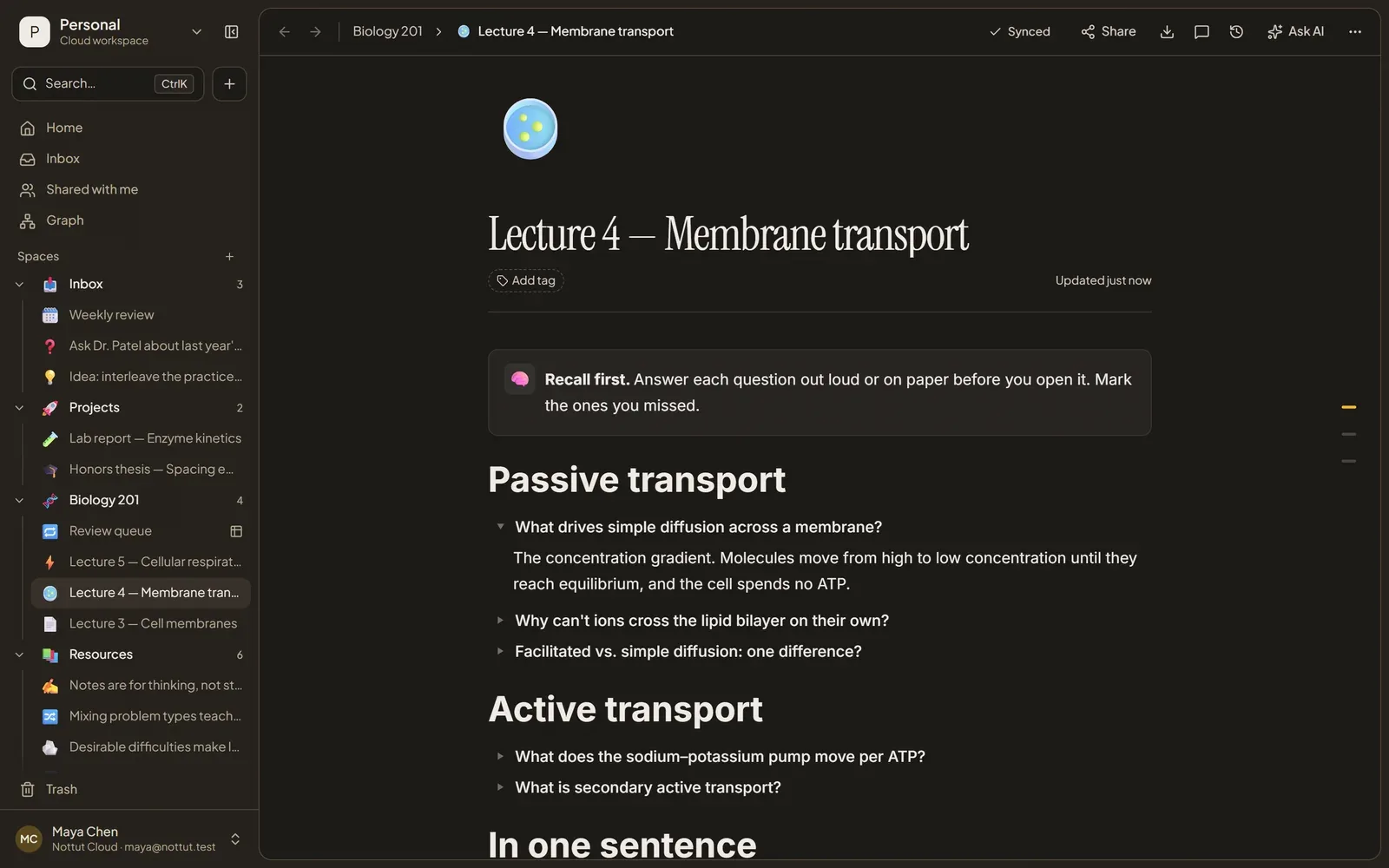
1. Write the lecture note as questions
Put each key point in a question, with the answer inside a toggle that stays closed. A short callout at the top reminds you of the rule: answer first, then open.
2. Recall before you reveal, and mark what you missed
Go through the questions without opening anything. Say or write each answer, then open the toggle to check. Anything you missed or only half knew goes into the review queue with a lower rating.
3. Keep a review queue
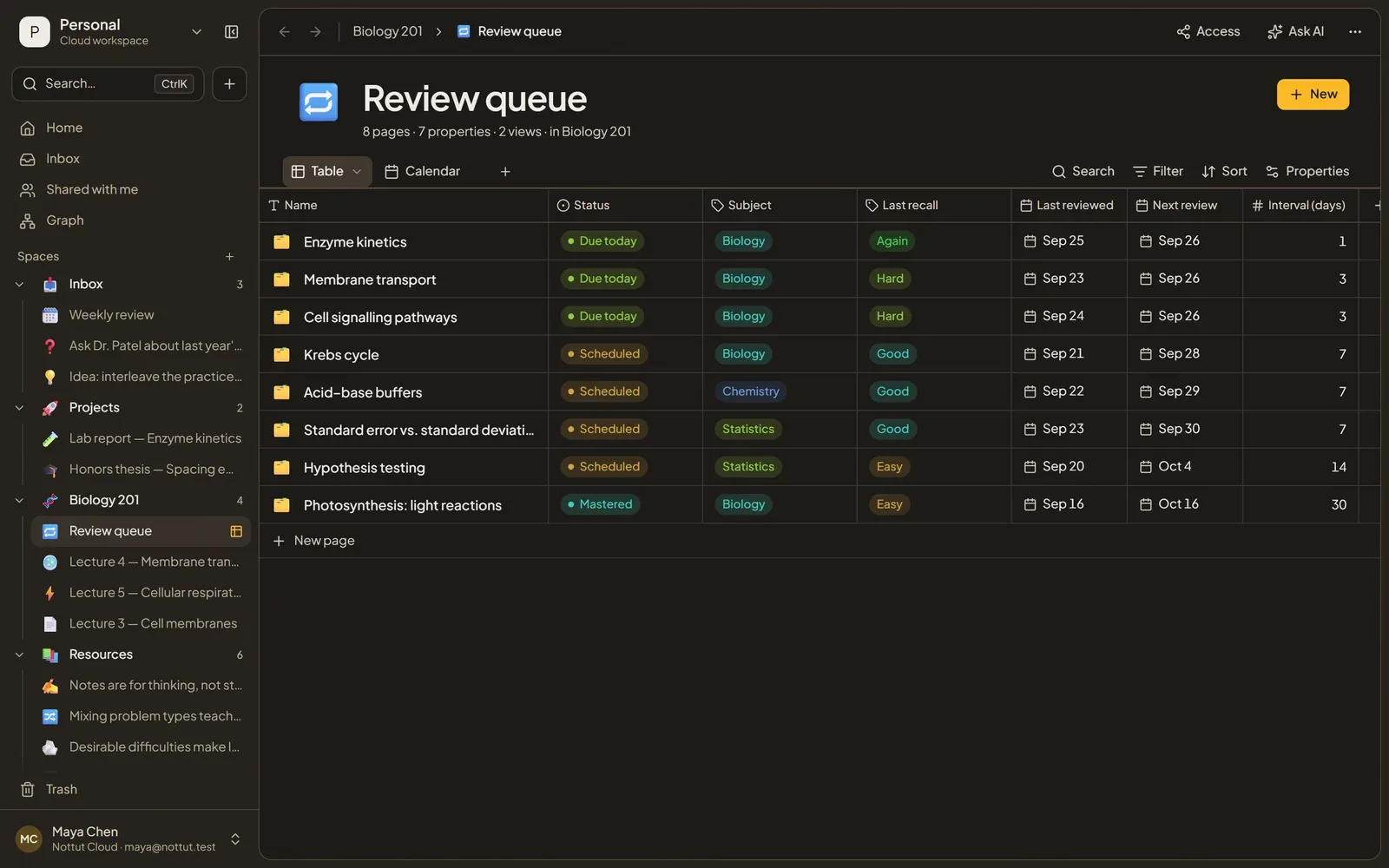
Make a small database with one row per topic, not per question. These columns are enough:
- Status: due today, scheduled or mastered
- Subject, so you can filter before an exam
- Last recall: Again, Hard, Good or Easy
- Last reviewed and Next review: dates
- Interval (days): the gap you are currently on
4. Set the next review from the rating
After each review, update the row: Again resets the interval to one day, Hard keeps it, Good doubles it and Easy triples it. Then set Next review to today plus the new interval, and keep the interval within the range your deadline allows.
5. Work from the calendar
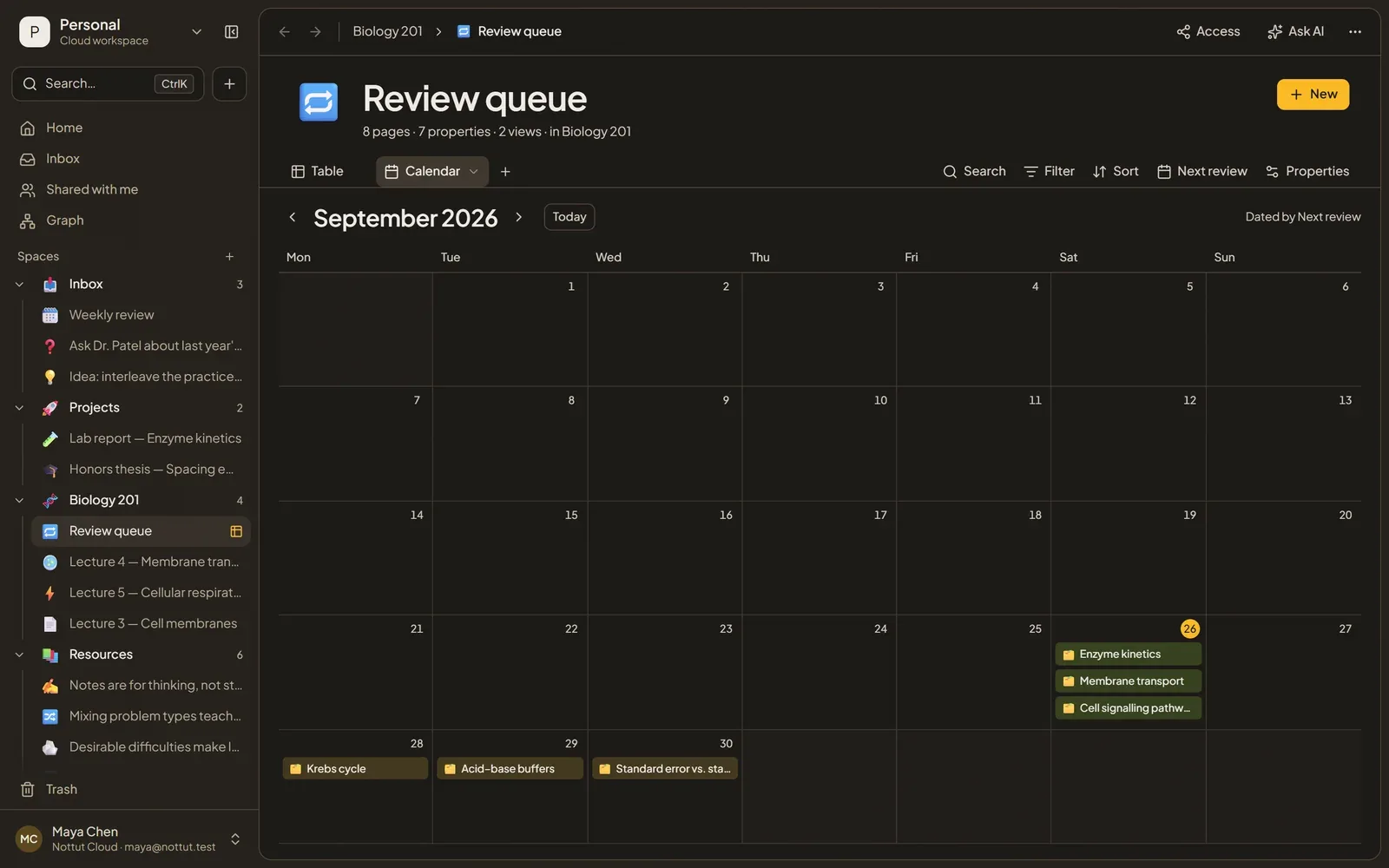
Switch the same database to a calendar view, dated by Next review. Today's square is your study list, and the rest of the week shows what is coming, so a heavy day never surprises you.
6. Once a week, tidy the queue
Clear anything that is overdue. Look at the topics you keep rating Again: they are usually too big. Split "The Krebs cycle" into "What goes in and out of the cycle?" and "Where is the most ATP made?". Move topics you consistently find easy to a long interval, or mark them mastered.
Common mistakes
- Recognizing instead of recalling. Reading the answer and thinking "yes, I knew that" is recognition. Say or write the answer before you look.
- Stopping after one correct answer. In one study, word pairs that students kept retrieving were recalled about 80% of the time a week later. Pairs dropped from practice after one correct recall fell to about a third. (Karpicke & Roediger, 2008)
- Gaps that are too short. Reviewing an hour after learning feels good and does little. Too short is the costlier mistake; too long is the milder one.
- Treating cramming as the plan. Cramming can get you through tomorrow's quiz, but most of it will be gone by the final.
- Questions that are too big. "Explain photosynthesis" is a chapter, not a question. Smaller questions give clearer feedback.
- Skipping the answer check. Recall without feedback can lock in a wrong answer.
- Only using flashcards for problem-solving subjects. For maths and science, practice mixed problems. In one small study, students who practiced mixed problem types scored 63% a week later, against 20% for those who practiced one type at a time, even though they did worse during practice. (Rohrer & Taylor, 2007)
Flashcard app or notes?
Both work. They are good at different things, and many students use both.
| Flashcard app (such as Anki) | Questions in your notes | |
|---|---|---|
| Best for | Large sets of discrete facts | Concepts, lectures, problem-solving |
| Scheduling | Automatic, per card | You set the next review with a simple rule |
| Context when you miss | The card alone | The explanation sits right under the question |
| Setup | A separate deck to build | Nothing extra: your notes are the deck |
A common split is an Anki deck for vocabulary or anatomy terms, and question-first notes with a review queue for everything conceptual.
FAQ
Is active recall better than rereading?
Yes. In controlled studies, students who tested themselves remembered much more a week later than students who spent the same time rereading, even though rereading felt more effective. In one experiment the difference was 61% against 40%. A major 2013 review rated practice testing high utility and rereading low utility.
How often should I review with spaced repetition?
Start with a review one day after learning, then after about three days, a week, two to three weeks and a month. Lengthen the gap when recall is easy and shorten it when you miss. The right gaps also depend on how long you need to remember the material.
How long should the gap be before an exam?
It depends on how far away the exam is. In spacing research, the best gap was about 20–40% of the time until the test for a test one week away, falling to about 5–10% for a test a year away. For an exam next week, review every one to three days. For a final two or three months away, gaps of two to three weeks work once a topic is stable.
What is the 1-3-7-14-30 schedule?
It is a fixed review schedule: after learning something, review it after 1, 3, 7, 14 and 30 days. It is a sensible default for material you need for a month or two. Research supports spacing in general, not these exact numbers, so stretch the later gaps if you need the material for longer.
What is the 2357 revision method?
It is an informal schedule popular with UK students: learn something on day 1, then review it on days 2, 3, 5 and 7. It has no research behind it as a specific schedule, and versions differ; some count backwards from the exam instead. Its short gaps suit an exam one or two weeks away. For anything you need to keep longer, let the later gaps grow.
What if I miss a review?
Do it as soon as you can and count the next gap from that day. A late review costs less than you might think: in spacing research, gaps that were too long hurt much less than gaps that were too short.
Can I do spaced repetition without flashcards?
Yes. Any form of retrieval counts: questions in your notes, a blank-page brain dump, or practice problems. What makes it spaced repetition is scheduling each review at a growing interval, which a simple database or calendar can do.
Does spaced repetition work for maths and problem solving?
Yes, especially combined with interleaving: mixing different types of problems in one session instead of practicing one type at a time. Spacing brings topics back; interleaving teaches you to recognize which method a problem needs, which is exactly what an exam tests.
The short version
Active recall makes each study session count, and spaced repetition makes it last. Write your notes as questions. Answer before you look, check the answer, and rate how it went. Let that rating, and your deadline, decide when the topic comes back.
Nottut gives you the parts for this system: toggles for question-first notes, a database for the review queue and a calendar view for the schedule. Get started free and set up your first review queue in a few minutes.
Related reading: The Cornell note-taking method · AI note-taking for students · The Zettelkasten method · How to turn notes into finished work
Sources
- Bjork, R. A. (1994). Memory and metamemory considerations in the training of human beings. In J. Metcalfe & A. P. Shimamura (Eds.), Metacognition: Knowing about knowing (pp. 185–205). MIT Press. doi.org/10.7551/mitpress/4561.001.0001
- Cepeda, N. J., Pashler, H., Vul, E., Wixted, J. T., & Rohrer, D. (2006). Distributed practice in verbal recall tasks: A review and quantitative synthesis. Psychological Bulletin, 132(3), 354–380. doi.org/10.1037/0033-2909.132.3.354
- Cepeda, N. J., Vul, E., Rohrer, D., Wixted, J. T., & Pashler, H. (2008). Spacing effects in learning: A temporal ridgeline of optimal retention. Psychological Science, 19(11), 1095–1102. doi.org/10.1111/j.1467-9280.2008.02209.x
- Dunlosky, J., Rawson, K. A., Marsh, E. J., Nathan, M. J., & Willingham, D. T. (2013). Improving students' learning with effective learning techniques. Psychological Science in the Public Interest, 14(1), 4–58. doi.org/10.1177/1529100612453266
- Karpicke, J. D., & Blunt, J. R. (2011). Retrieval practice produces more learning than elaborative studying with concept mapping. Science, 331(6018), 772–775. doi.org/10.1126/science.1199327
- Karpicke, J. D., & Roediger, H. L. (2008). The critical importance of retrieval for learning. Science, 319(5865), 966–968. doi.org/10.1126/science.1152408
- Leitner, S. (1972). So lernt man lernen. Herder.
- Murre, J. M. J., & Dros, J. (2015). Replication and analysis of Ebbinghaus' forgetting curve. PLOS ONE, 10(7), e0120644. doi.org/10.1371/journal.pone.0120644
- Roediger, H. L., & Karpicke, J. D. (2006). Test-enhanced learning: Taking memory tests improves long-term retention. Psychological Science, 17(3), 249–255. doi.org/10.1111/j.1467-9280.2006.01693.x
- Rohrer, D., & Taylor, K. (2007). The shuffling of mathematics problems improves learning. Instructional Science, 35(6), 481–498. doi.org/10.1007/s11251-007-9015-8
- Rowland, C. A. (2014). The effect of testing versus restudy on retention: A meta-analytic review of the testing effect. Psychological Bulletin, 140(6), 1432–1463. doi.org/10.1037/a0037559