How to Take Better Notes: What the Research Says
How to take better notes, backed by research: why reviewing matters most, what to capture, laptop vs paper, and a before, during and after class routine.
To take better notes, capture more of the lecture than feels necessary, give it a structure you can review, and put ideas in your own words when there is time. Then test yourself on those notes over the next few days. That last step matters most: across dozens of studies, reviewing notes helps far more than taking them.
This guide sums up what the research shows, with the actual numbers, and turns it into a routine for before, during and after class.
Key takeaways
- Notes are mostly for later. Taking notes without reviewing them gives a small benefit; taking them and then reviewing them gives a large one.
- Most notes are incomplete. Students typically record about a third of a lecture's important ideas, and far fewer of its examples.
- Use your own words when you can. Paraphrasing beat copying word for word in lab studies, although fuller notes help too.
- Laptop or paper matters less than you have heard. Distraction is the bigger risk.
- Review by testing yourself, spread over days. Turn notes into questions and answer them before you look.
Table of contents
- Why notes help: writing them vs reviewing them
- Your notes are probably missing most of the lecture
- Before class: give your notes a frame
- During class: capture, don't transcribe
- Laptop or paper?
- After class: fill the gaps, then test yourself
- Which note-taking method should you use?
- A routine that puts it together
- How to take better notes in Nottut
- Note-taking myths
- FAQ
Why notes help: writing them vs reviewing them
Researchers split note-taking into two jobs. Writing notes helps you process the lecture as you hear it (the encoding function), and the notes you keep let you review it later (the external storage function). Di Vesta and Gray described this split in 1972, and studies since have measured both.
- Writing alone helps a little. A meta-analysis of 57 studies found that taking notes without reviewing them improved test performance by an effect size of 0.22, which is small (Kobayashi, 2005).
- Writing plus reviewing helps a lot. A second meta-analysis found that students who took notes and then reviewed them outscored comparison groups with no notes to review by effect sizes of 0.75 to 0.77 (Kobayashi, 2006).
- Doing both beats either one. When the two were tested head to head, students who took and reviewed their notes recalled more than students who only took notes or only reviewed someone else's (Kiewra et al., 1991).
The two meta-analyses cover different studies, so their numbers should not be subtracted from each other. The direction is clear, though: notes pay off mostly when you come back to them. Write them for the person who will review them next week.
Your notes are probably missing most of the lecture
On average, students record about a third of a lesson's important ideas (Kiewra, Colliot & Lu, 2018, summarizing several studies). The gaps are not random:
- Details go first. In one study, students recorded 91% of a lecture's most important ideas but only 11% of its finest details.
- Examples go too. Another study found students' notes covered only 13% of the examples teachers gave.
- Speed is the problem. Lectures run at about 120 to 180 words a minute, while students type about 33 and write by hand about 22.
All three figures are from studies reviewed by Kiewra, Colliot and Lu (2018).
Completeness matters. In one study, the quality of students' notes was the only significant predictor of their test scores (Peverly et al., 2007). Notes with more in them predicted better recall (Bui, Myerson & Hale, 2013), and in a replication of the famous laptop study, students who wrote more words scored higher (Urry et al., 2021).
So the first fix is simple: capture more. Write down examples, not just headings. Use abbreviations, and leave gaps you can fill in after class.
Before class: give your notes a frame
Notes are easier to take when you know the shape of the lecture before it starts.
- Skim the slides or the reading and write down two or three questions you want answered. You will listen for the answers.
- Use the instructor's materials as a skeleton. In a meta-analysis of note-taking interventions, the ones that gave students notes or a framework had an average effect of 0.41, against 0.19 for the ones that did not. The interventions also helped lower-achieving students more than higher achievers (0.53 against 0.29; Kobayashi, 2006).
- Partial notes work well. With partial notes to fill in, students recorded 56% of the important ideas, against 38% when they started from a blank page (Kiewra et al., 1995, as reported by Kiewra, Colliot & Lu, 2018).
If your instructor posts slides, bring them into your notes and write around them instead of copying them out.
During class: capture, don't transcribe
Two findings pull in slightly different directions here, and both are useful.
Your own words build understanding. In classic lab studies, students who summarized or paraphrased as they took notes did better than students who copied word for word (Bretzing & Kulhavy, 1979). Compared with students who only listened, note-takers did better on problems that required applying the ideas, and worse on questions that repeated the lecture closely (Peper & Mayer, 1978, 1986). Putting ideas into your own words is what builds that understanding.
More notes also help. Word-for-word notes are longer, and longer notes hold more to review. In one set of experiments, typing a transcript gave the best immediate recall and organized notes gave the best delayed recall; when students could study their notes before the delayed test, the transcribers did better (Bui, Myerson & Hale, 2013).
The practical answer: when the lecture is fast, get it down; when it slows, rephrase. Then rewrite the key points in your own words after class.
Give your notes structure as you go.
- Start a new heading whenever the topic changes.
- When a lecture compares several things on the same features, put them in a table. Students who reviewed notes laid out as a matrix or an outline recalled more than those who reviewed plain text, and only the matrix group did better on transfer questions (Kiewra et al., 1988). Graphic organizers also beat outlines for learning how ideas relate to each other (Robinson & Kiewra, 1995).
Laptop or paper?
You have probably heard that handwriting beats typing. The study behind that claim found that laptop users did worse on conceptual questions and blamed word-for-word transcription (Mueller & Oppenheimer, 2014). It has not held up well:
- Two direct replications found no reliable difference in test scores (Morehead, Dunlosky & Rawson, 2019; Urry et al., 2021).
- The most recent meta-analysis, of 24 studies with college students, found a small advantage for handwritten notes (g = 0.25), larger when the notes were reviewed (g = 0.42). Typed notes, meanwhile, held far more (g = 0.92 for note length; Flanigan et al., 2024).
The clearer risk is distraction. In a randomized trial at West Point, classes where computers were allowed scored about 0.2 standard deviations lower on the final exam (Carter, Greenberg & Walker, 2017). When researchers logged students' internet use in class, non-academic browsing went with lower exam scores, even after accounting for motivation, interest and intelligence (Ravizza, Uitvlugt & Fenn, 2017). Laptop multitasking also lowered the scores of students sitting nearby (Sana, Weston & Cepeda, 2013).
So use whichever you prefer. If you type, close everything else, and paraphrase instead of transcribing.
After class: fill the gaps, then test yourself
This is where most of the benefit is.
- Fill the gaps the same day. Add what you missed, fix what is unclear and finish half-written examples. Students who revised their notes outscored students who simply recopied them, especially on questions about how ideas relate (Luo, Kiewra & Samuelson, 2016).
- Turn key points into questions. Write a question for each main idea and hide the answer.
- Test yourself before you reread. Testing yourself beats rereading when the test comes two days or a week later, even though rereading looks better five minutes after studying (Roediger & Karpicke, 2006). A meta-analysis found that practice tests beat restudying across studies (Adesope, Trevisan & Sundararajan, 2017), and a large review of ten study techniques rated practice testing and spaced practice as the only two with high utility; rereading, highlighting and summarizing were rated low (Dunlosky et al., 2013).
- Space the reviews out. The same study time spread over several days is remembered longer than one long session (Cepeda et al., 2006).
A note on the "review within 24 hours" rule you will see everywhere: it is a sensible habit, but we found no study that tests that exact window, and one early study found no effect of the delay before review (Di Vesta & Gray, 1973). What the evidence supports is testing yourself repeatedly, with gaps in between.
Which note-taking method should you use?
University learning centers usually teach the same five methods (UNC Learning Center; University of Georgia OSSA). Choose by the lecture, not by habit:
| Method | Looks like | Best for |
|---|---|---|
| Outline | Headings with indented points | Lectures with a clear hierarchy |
| Cornell | Notes on the right, questions on the left, a summary at the bottom | Anything you will be tested on |
| Charting (matrix) | A table with items in rows and features in columns | Comparing several things on the same features |
| Mapping | A central idea with linked branches | Seeing how concepts relate |
| Sentence | One numbered line for each new idea | Fast lectures with little structure; rewrite later |
A word on mind maps: the evidence is thinner than their popularity suggests. A meta-analysis of 55 studies found that learning with concept maps went with better retention, but building a map beat writing a summary or an outline only slightly (g = 0.19; Nesbit & Adesope, 2006). The often-quoted "10–15% better recall" for mind maps comes from one study of 50 medical students, in which the confidence interval for the 10% estimate included zero (Farrand, Hussain & Hennessy, 2002).
For the Cornell layout, our free Cornell notes template has printable and digital versions.
A routine that puts it together
| When | What to do | Why it helps |
|---|---|---|
| Before class (10 minutes) | Skim the slides, write two or three questions, bring the slides in as a frame | Frameworks and provided notes help most |
| During class | Capture more than feels necessary: a heading per topic, a table for comparisons; phone and other tabs away | Notes are usually incomplete, and distraction lowers scores |
| Same day (15 minutes) | Fill the gaps, rewrite key points in your own words, turn them into questions | Revising beats recopying, and questions set up self-testing |
| Over the next few days | Answer the questions before rereading, then review what you missed | Retrieval practice |
| Every week | Revisit older lectures, leaving longer gaps each time | Spaced practice |
How to take better notes in Nottut
Nottut is a note-taking app, so here is how the routine above looks inside it. Everything below uses ordinary blocks you add by typing /.
Set up a lecture template once. Create a page with a callout for your before-class questions, headings for the notes, a Test yourself heading and a summary callout at the bottom. Open the ··· menu at the top right and choose Save as template. From then on, every lecture starts from Home → Templates. Our Cornell notes template guide shows the steps with screenshots.
Before class, type your questions into the callout and attach the slides with /file, so they sit right next to your notes.
During class, start a new heading whenever the topic changes. When the lecture compares several things, type /table and fill in a matrix as you listen.
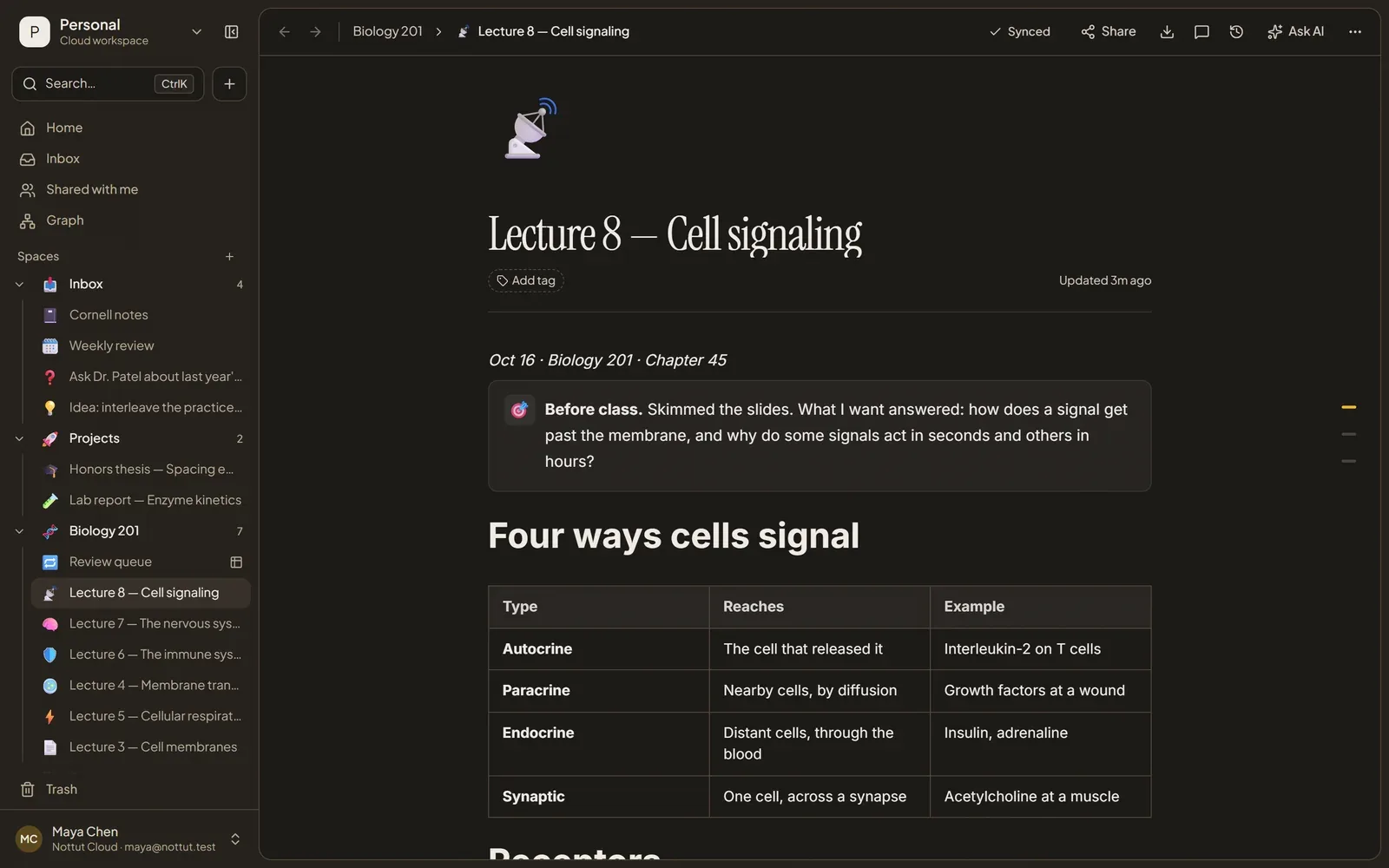
After class, turn each main idea into a question. Type /toggle, write the question as the toggle's title and put the answer inside, so it stays hidden until you have tried. Then write the summary in your own words. If you use AI, use it afterwards: select your notes, open the AI menu in the toolbar that appears, and choose Summarize to see what your own summary missed, rather than letting it write the summary for you.
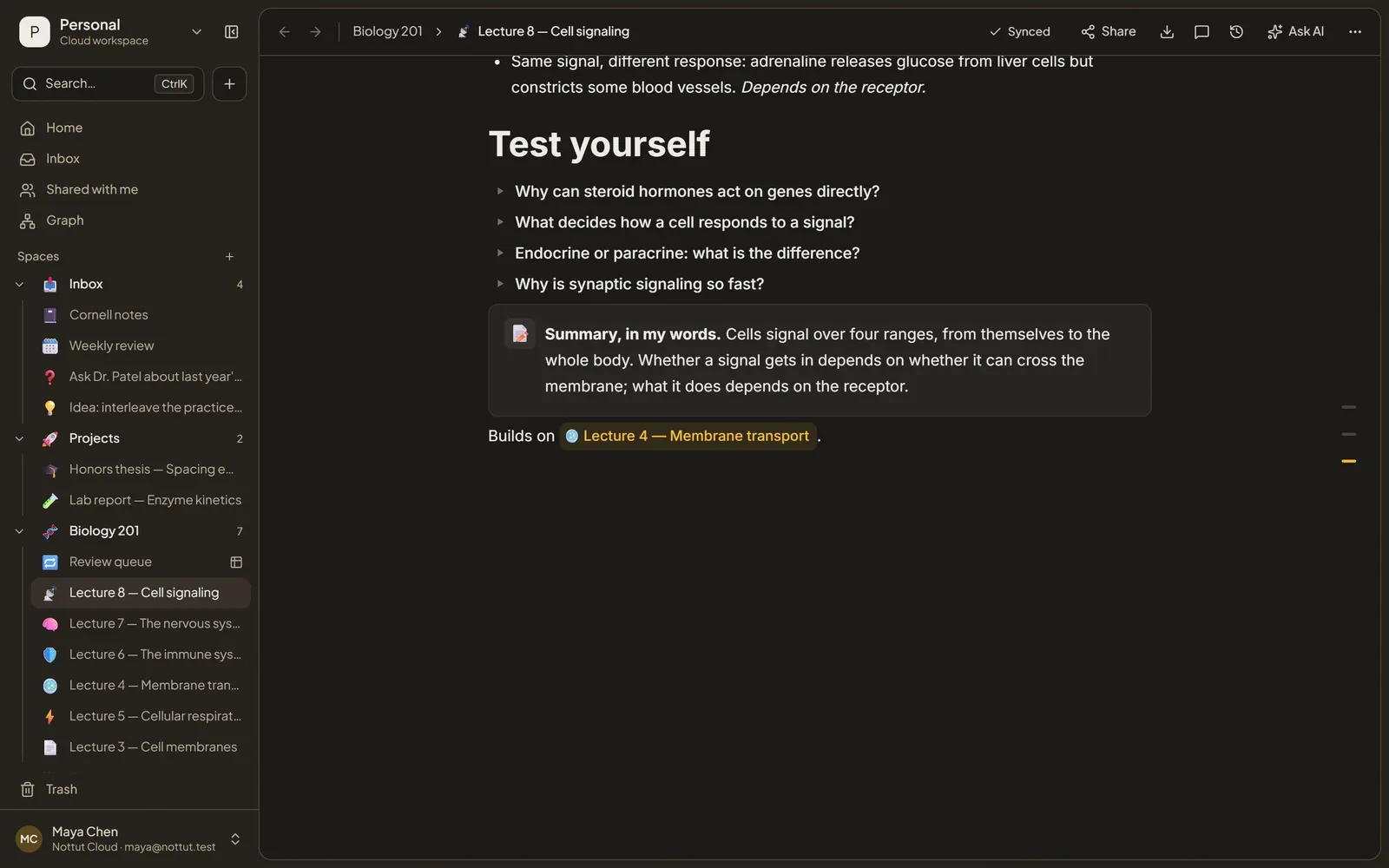
Connect it. Type [[ and the name of an earlier lecture to link to it. The earlier note then lists every page that links to it at the bottom, so reopening Lecture 4 shows where its ideas came back. The Graph view shows how a whole course fits together.

Schedule the reviews. Keep a review queue with a date for each topic's next review, and work from its calendar view. Our active recall and spaced repetition guide shows how to build one in Nottut.
Note-taking myths
- "Handwriting is always better." The evidence ranges from no difference to a small advantage, depending on the study, as described above.
- "We forget 75% of a lecture within a day." This figure circulates without a source. Ebbinghaus measured how long it took one person to relearn lists of nonsense syllables; after a day, relearning took about two-thirds of the original time (Murre & Dros, 2015). That says little about meaningful lecture material.
- "Match your note-taking method to your learning style." There is virtually no evidence that matching methods to a "visual" or "verbal" learning style improves learning (Pashler et al., 2008).
- "Review within 24 hours or it's gone." A sensible habit, but not a tested rule. Spaced self-testing is what the evidence supports.
FAQ
What is the best way to take notes?
Capture as much of the important content as you can, including examples, in a structure you can review: headings, a table for comparisons, or the Cornell layout. Then turn the notes into questions and test yourself over the following days. Reviewing does more for your results than the note-taking method you choose.
How can I take notes faster?
Use abbreviations and symbols, write phrases instead of full sentences, and skip what is already on the slides. Leave gaps to fill in after class instead of trying to catch every word. If you type, a template with your usual headings saves setup time in every lecture.
Should I record lectures instead of taking notes?
A recording is a backup, not a replacement, and many courses require permission first. It does help you fill gaps: in one study, students watching a lecture a second time noted 53% of its details, against 38% after a single viewing (Kiewra, Mayer et al., 1991, as reported by Kiewra, Colliot & Lu, 2018). The learning still comes from reviewing and testing yourself afterwards.
Is it better to type or handwrite notes?
Neither is clearly better. Replications of the well-known 2014 study found no reliable difference, and the latest meta-analysis found a small edge for handwriting that grew when notes were reviewed. Typed notes hold far more. Choose the one you will actually review, and keep other apps closed if you type.
How often should I review my notes?
Once soon after class to fill the gaps, then a few more times at growing intervals, such as a few days later and again a week after that. Start each review with recall: answer your questions before you reread.
What are the 5 methods of note-taking?
Outline, Cornell, charting (a matrix table), mapping and the sentence method. Many students do best with a mix: an outline or sentences during a fast lecture, a table for comparisons, and Cornell-style questions afterwards.
The short version
Take fuller notes than feels necessary, give them structure, and rephrase what you can. Then spend your time reviewing: answer questions from memory, spread over several days. Paper or laptop matters less than keeping distractions away. If you want the whole routine in one place, try Nottut free: lecture templates, tables, question toggles and linked notes.
Related reading: Free Cornell notes template · Active recall and spaced repetition · How to turn notes into finished work
Sources
- Adesope, O. O., Trevisan, D. A., & Sundararajan, N. (2017). Rethinking the use of tests: A meta-analysis of practice testing. Review of Educational Research, 87(3), 659–701. doi:10.3102/0034654316689306
- Bretzing, B. H., & Kulhavy, R. W. (1979). Notetaking and depth of processing. Contemporary Educational Psychology, 4(2), 145–153. doi:10.1016/0361-476X(79)90069-9
- Bui, D. C., Myerson, J., & Hale, S. (2013). Note-taking with computers: Exploring alternative strategies for improved recall. Journal of Educational Psychology, 105(2), 299–309. doi:10.1037/a0030367
- Carter, S. P., Greenberg, K., & Walker, M. S. (2017). The impact of computer usage on academic performance: Evidence from a randomized trial at the United States Military Academy. Economics of Education Review, 56, 118–132. doi:10.1016/j.econedurev.2016.12.005
- Cepeda, N. J., Pashler, H., Vul, E., Wixted, J. T., & Rohrer, D. (2006). Distributed practice in verbal recall tasks: A review and quantitative synthesis. Psychological Bulletin, 132(3), 354–380. doi:10.1037/0033-2909.132.3.354
- Di Vesta, F. J., & Gray, G. S. (1972). Listening and note taking. Journal of Educational Psychology, 63(1), 8–14. doi:10.1037/h0032243
- Di Vesta, F. J., & Gray, G. S. (1973). Listening and note taking: II. Journal of Educational Psychology, 64(3), 278–287. doi:10.1037/h0034589
- Dunlosky, J., Rawson, K. A., Marsh, E. J., Nathan, M. J., & Willingham, D. T. (2013). Improving students' learning with effective learning techniques. Psychological Science in the Public Interest, 14(1), 4–58. doi:10.1177/1529100612453266
- Farrand, P., Hussain, F., & Hennessy, E. (2002). The efficacy of the "mind map" study technique. Medical Education, 36(5), 426–431. doi:10.1046/j.1365-2923.2002.01205.x
- Flanigan, A. E., Wheeler, J., Colliot, T., Lu, J., & Kiewra, K. A. (2024). Typed versus handwritten lecture notes and college student achievement: A meta-analysis. Educational Psychology Review, 36, 78. doi:10.1007/s10648-024-09914-w
- Kiewra, K. A., Benton, S. L., Kim, S.-I., Risch, N., & Christensen, M. (1995). Effects of note-taking format and study technique on recall and relational performance. Contemporary Educational Psychology, 20(2), 172–187. doi:10.1006/ceps.1995.1011
- Kiewra, K. A., Colliot, T., & Lu, J. (2018). Note this: How to improve student note taking (IDEA Paper No. 73). IDEA Center. ERIC ED588353
- Kiewra, K. A., DuBois, N. F., Christian, D., & McShane, A. (1988). Providing study notes: Comparison of three types of notes for review. Journal of Educational Psychology, 80(4), 595–597. doi:10.1037/0022-0663.80.4.595
- Kiewra, K. A., DuBois, N. F., Christian, D., McShane, A., Meyerhoffer, M., & Roskelley, D. (1991). Note-taking functions and techniques. Journal of Educational Psychology, 83(2), 240–245. doi:10.1037/0022-0663.83.2.240
- Kiewra, K. A., Mayer, R. E., Christensen, M., Kim, S.-I., & Risch, N. (1991). Effects of repetition on recall and note-taking: Strategies for learning from lectures. Journal of Educational Psychology, 83(1), 120–123. doi:10.1037/0022-0663.83.1.120
- Kobayashi, K. (2005). What limits the encoding effect of note-taking? A meta-analytic examination. Contemporary Educational Psychology, 30(2), 242–262. doi:10.1016/j.cedpsych.2004.10.001
- Kobayashi, K. (2006). Combined effects of note-taking/-reviewing on learning and the enhancement through interventions: A meta-analytic review. Educational Psychology, 26(3), 459–477. doi:10.1080/01443410500342070
- Luo, L., Kiewra, K. A., & Samuelson, L. (2016). Revising lecture notes: How revision, pauses, and partners affect note taking and achievement. Instructional Science, 44(1), 45–67. doi:10.1007/s11251-016-9370-4
- Morehead, K., Dunlosky, J., & Rawson, K. A. (2019). How much mightier is the pen than the keyboard for note-taking? A replication and extension of Mueller and Oppenheimer (2014). Educational Psychology Review, 31(3), 753–780. doi:10.1007/s10648-019-09468-2
- Mueller, P. A., & Oppenheimer, D. M. (2014). The pen is mightier than the keyboard: Advantages of longhand over laptop note taking. Psychological Science, 25(6), 1159–1168. doi:10.1177/0956797614524581
- Murre, J. M. J., & Dros, J. (2015). Replication and analysis of Ebbinghaus' forgetting curve. PLOS ONE, 10(7), e0120644. doi:10.1371/journal.pone.0120644
- Nesbit, J. C., & Adesope, O. O. (2006). Learning with concept and knowledge maps: A meta-analysis. Review of Educational Research, 76(3), 413–448. doi:10.3102/00346543076003413
- Pashler, H., McDaniel, M., Rohrer, D., & Bjork, R. (2008). Learning styles: Concepts and evidence. Psychological Science in the Public Interest, 9(3), 105–119. doi:10.1111/j.1539-6053.2009.01038.x
- Peper, R. J., & Mayer, R. E. (1978). Note taking as a generative activity. Journal of Educational Psychology, 70(4), 514–522. doi:10.1037/0022-0663.70.4.514
- Peper, R. J., & Mayer, R. E. (1986). Generative effects of note-taking during science lectures. Journal of Educational Psychology, 78(1), 34–38. doi:10.1037/0022-0663.78.1.34
- Peverly, S. T., Ramaswamy, V., Brown, C., Sumowski, J., Alidoost, M., & Garner, J. (2007). What predicts skill in lecture note taking? Journal of Educational Psychology, 99(1), 167–180. doi:10.1037/0022-0663.99.1.167
- Ravizza, S. M., Uitvlugt, M. G., & Fenn, K. M. (2017). Logged in and zoned out: How laptop internet use relates to classroom learning. Psychological Science, 28(2), 171–180. doi:10.1177/0956797616677314
- Robinson, D. H., & Kiewra, K. A. (1995). Visual argument: Graphic organizers are superior to outlines in improving learning from text. Journal of Educational Psychology, 87(3), 455–467. doi:10.1037/0022-0663.87.3.455
- Roediger, H. L., & Karpicke, J. D. (2006). Test-enhanced learning: Taking memory tests improves long-term retention. Psychological Science, 17(3), 249–255. doi:10.1111/j.1467-9280.2006.01693.x
- Sana, F., Weston, T., & Cepeda, N. J. (2013). Laptop multitasking hinders classroom learning for both users and nearby peers. Computers & Education, 62, 24–31. doi:10.1016/j.compedu.2012.10.003
- UNC Learning Center. Effective note-taking in class. learningcenter.unc.edu
- University of Georgia, Office of Student Success and Achievement. Note-taking methods. ossa.uga.edu
- Urry, H. L., et al. (2021). Don't ditch the laptop just yet: A direct replication of Mueller and Oppenheimer's (2014) Study 1 plus mini meta-analyses across similar studies. Psychological Science, 32(3), 326–339. doi:10.1177/0956797620965541