What Is a Literature Review? How to Write One in 7 Steps
A literature review shows what research knows about a question and where it disagrees. Learn the review types and 7 steps to write one, with an example.
A literature review is a structured account of what published research says about a question: what is known, where studies agree and disagree, and what is still missing. It is not a list of summaries. A good review groups studies by idea, compares their findings, and ends by showing where your own work fits.
This guide explains the main types of literature reviews, then walks through seven steps to write one, using a real question as a worked example: does typing or handwriting lecture notes lead to better learning? For finished sample paragraphs and an APA template, see our literature review examples.
Key takeaways
- A literature review synthesizes; it does not summarize. Organize it around concepts and questions, not around one source at a time.
- Choose the type before you search. A narrative review, a scoping review and a systematic review need very different amounts of searching, screening and reporting.
- Most of the work happens before you write: a focused question, a logged search, clear inclusion rules, structured notes and a literature matrix.
- The matrix is where synthesis starts. Put sources in rows and concepts in columns, and the agreements, conflicts and gaps become visible.
- End with the gap. The conclusion says what the research shows, what it does not, and how your question follows from that.
Table of contents
- What is a literature review?
- What a literature review is not
- Types of literature reviews
- How to write a literature review in 7 steps
- A worked example: typing versus handwriting notes
- How long should a literature review be?
- How to run a literature review in Nottut
- FAQ
What is a literature review?
University writing guides describe the same core idea in slightly different words. The UNC Writing Center calls a literature review a discussion of published information in a particular subject area. Purdue's Online Writing Lab describes it as bringing key sources together and discussing them "in conversation with each other." USC Libraries add the critical part: a review describes, summarizes and evaluates earlier research in relation to the research problem.
A literature review usually does four jobs:
- Maps what is known about a question, and how that knowledge developed.
- Compares studies: where they agree, where they conflict, and why they might conflict.
- Evaluates the evidence: which studies are strong, which methods limit what they can show.
- Identifies the gap that your study, thesis or proposal will address.
Webster and Watson, in a widely cited guide for researchers, put the key distinction in one line: a literature review is concept-centric. A review organized author by author ("Smith found… Jones found…") summarizes; a review organized concept by concept synthesizes.
What a literature review is not
- Not an annotated bibliography. An annotated bibliography describes each source on its own. A literature review discusses sources together, so the same study can appear in several sections.
- Not a book report of the field. Purdue OWL suggests a quick test: if every paragraph discusses only one source, you are probably summarizing rather than synthesizing.
- Not neutral listing. You are expected to judge the evidence: a well-designed replication with a large sample can outweigh an early, small study.
Types of literature reviews
Grant and Booth analyzed 14 review types and compared them on four dimensions: how they search, appraise, synthesize and analyze (SALSA). The types you are most likely to meet:
| Type | What it involves |
|---|---|
| Narrative (traditional) review | Selects and discusses key research on a topic. Common in theses, articles and course papers. Search and selection are not fully reported. |
| Integrative review | Reviews, critiques and synthesizes the literature on a topic so that new frameworks or perspectives emerge (Torraco). |
| Scoping review | Maps the extent and kind of research on a broad question, sometimes to decide whether a systematic review is worth doing (Arksey & O'Malley). Reported with the PRISMA-ScR checklist: 20 essential items and 2 optional ones. |
| Systematic review | Answers a focused question with a predefined, reproducible search, screening and appraisal. Reported with the 27-item PRISMA 2020 checklist and a flow diagram. |
| Meta-analysis | Combines the results of comparable studies statistically into a pooled effect. Usually part of a systematic review. |
If your instructor or supervisor just says "write a literature review," they almost always mean a narrative review. Snyder points out that traditional reviews are often done ad hoc rather than following a method; the steps below give yours one. They also scale up: a systematic review does the same things with more rigor and full reporting.
How to write a literature review in 7 steps
1. Define a focused question
A broad topic ("note-taking") gives you thousands of studies and no structure. A question gives you a way to decide what belongs. Write it down with its boundaries:
- Question: Does typing or handwriting lecture notes lead to better learning?
- Population: college students.
- Outcome: test performance after a lecture.
- Scope: experiments, replications and meta-analyses published in English.
2. Search systematically, and keep a search log
Search at least two databases suited to your field (for example ERIC and PsycINFO for education, PubMed for health, Google Scholar for breadth). Combine terms with Boolean operators, for example ("note taking" OR notetaking) AND (laptop OR typing) AND (longhand OR handwriting).
Then follow the citations. Backward snowballing means checking a key paper's reference list; forward snowballing means checking the papers that later cited it. Wohlin's guidelines describe both as a way to find studies that keyword searches miss.
Log every search: date, database, exact query, filters and number of results. The log lets you repeat the search, update it later, and explain your method in a sentence or two.
3. Screen sources against clear criteria
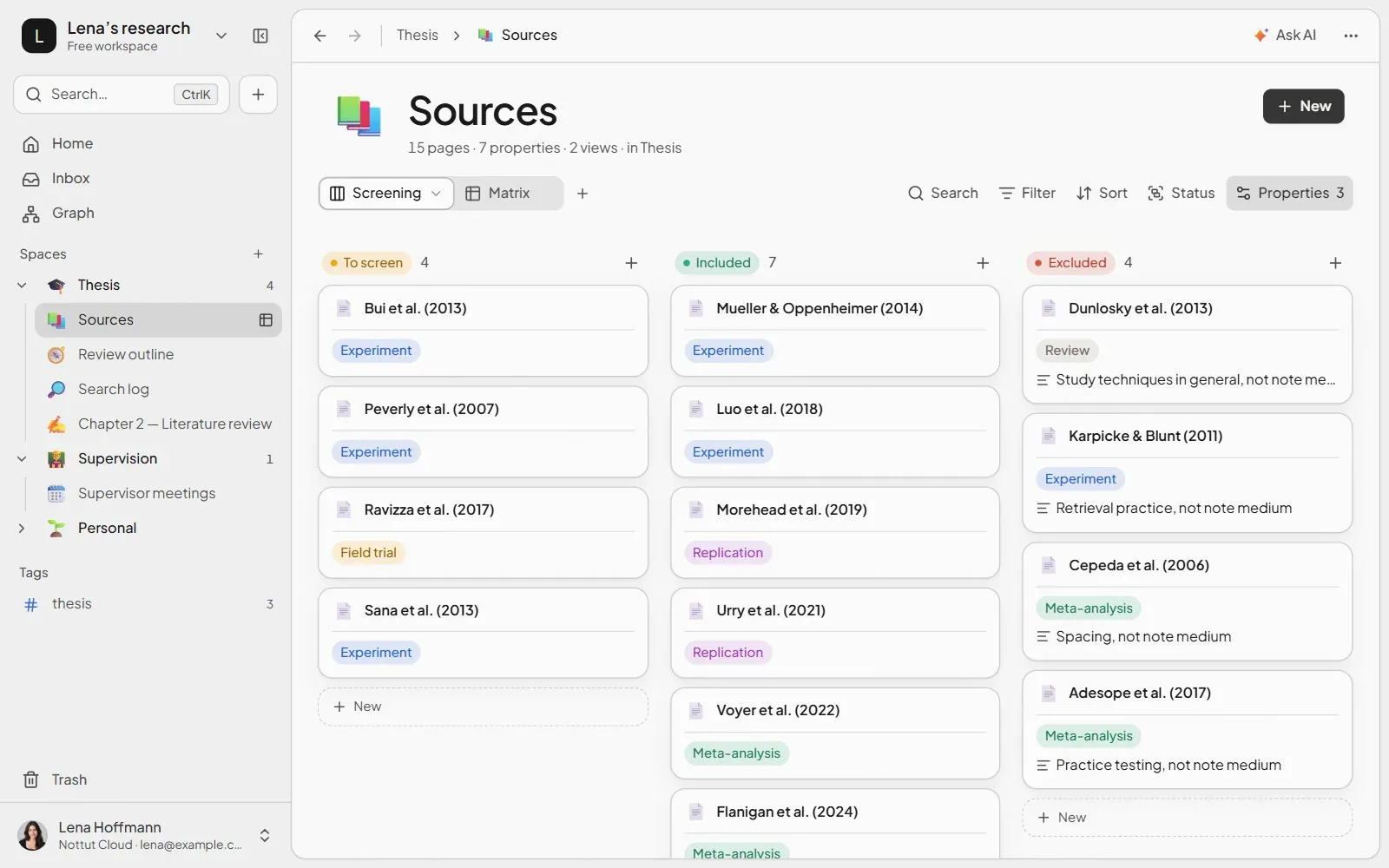
Write inclusion and exclusion rules before you read in depth, then apply them in two passes: first titles and abstracts, then full texts. Record why each source was excluded. In our example, a meta-analysis of retrieval practice is excellent research but off-question: it is about how students study, not about the medium they take notes in.
Systematic reviews report these numbers in a PRISMA flow diagram. Even for a narrative review, knowing how many sources you screened and why you kept the rest makes your review easier to defend.
4. Read and take structured notes, one note per source
Use the same headings for every source, so you can compare them later:
- Question: what the study asked.
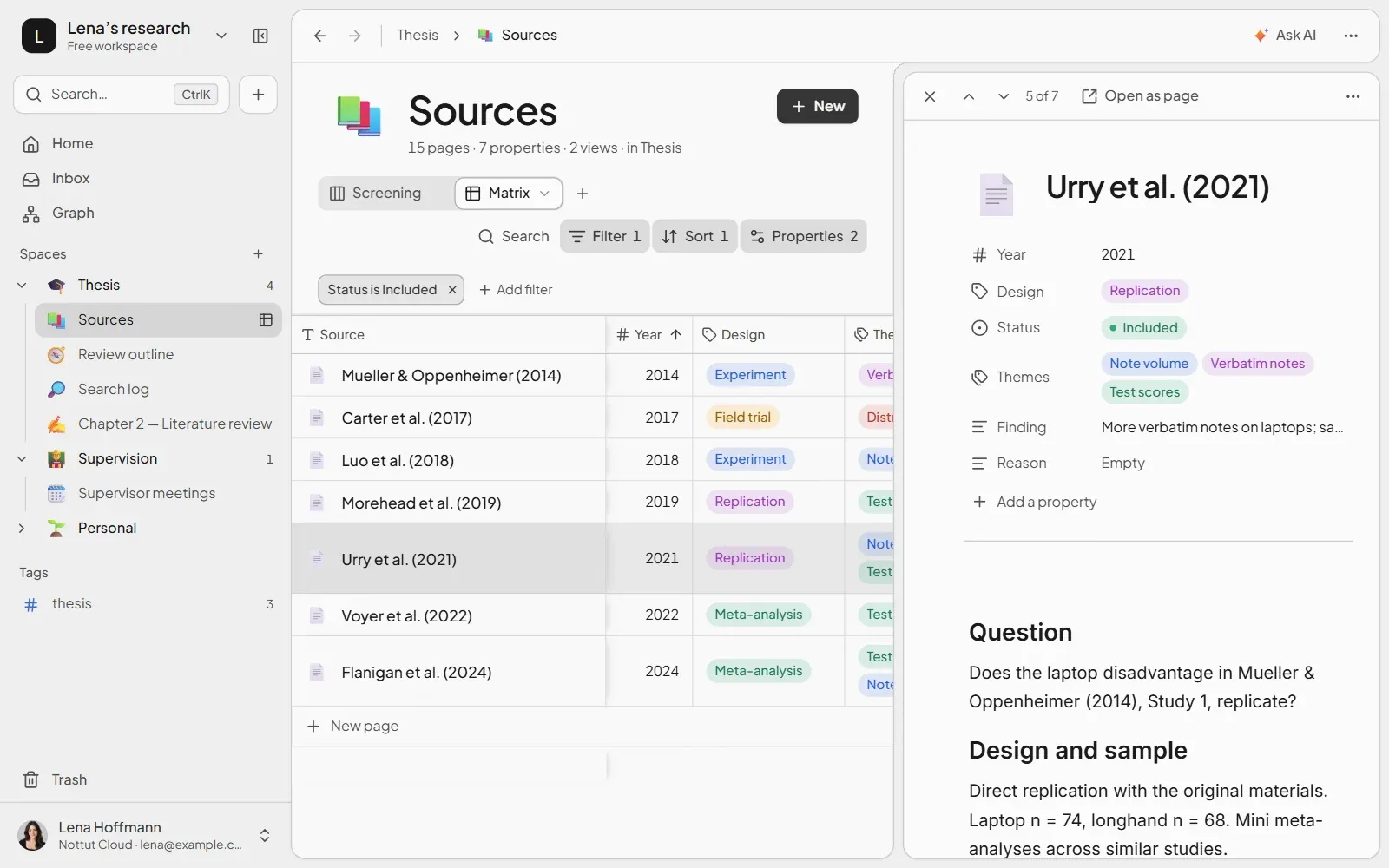
- Design and sample: experiment, replication, meta-analysis; who and how many.
- Findings: the result, with numbers and page references.
- Limitations: what the design cannot show.
- Why it matters for my question: one sentence in your own words.
Writing the last line forces you to think about the study, not just copy it, and it becomes raw material for your synthesis.
5. Build a literature matrix
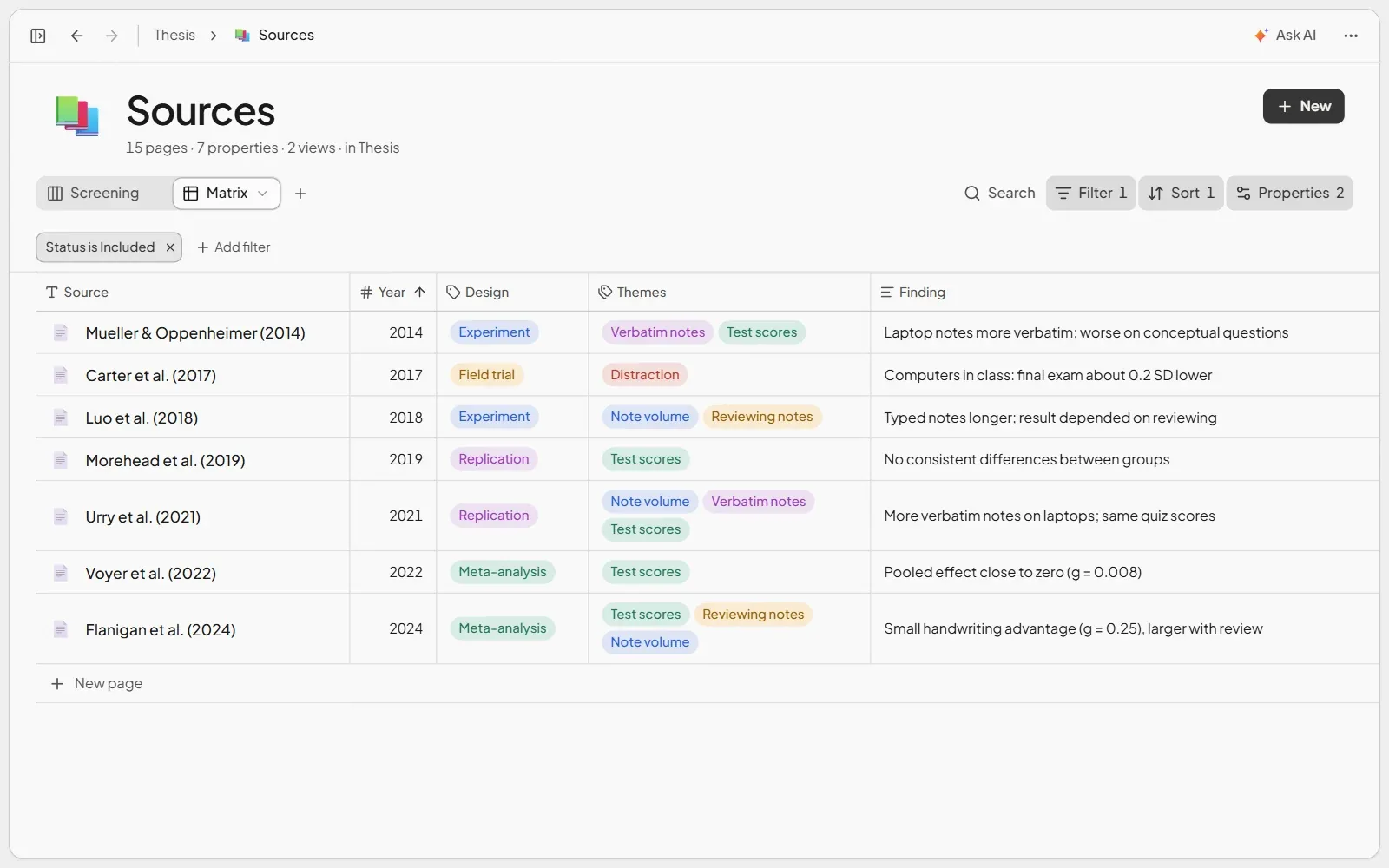
A literature matrix (also called a synthesis matrix or concept matrix) puts sources in rows and concepts in columns. Webster and Watson recommend building one while you read; the "matrix method" taught in health sciences does the same with columns for purpose, design, sample and results.
Once the matrix exists, synthesis questions answer themselves: which studies support a claim, which contradict it, and which concepts have no studies at all.
6. Find themes and choose a structure
Look down the columns of your matrix for patterns: findings that repeat, findings that conflict, and methods that might explain the conflict. Then choose a structure:
- Thematic: one section per theme. The most common structure in the social sciences.
- Chronological: how understanding changed over time. Useful when a finding was overturned.
- Methodological: grouped by research method, when the method explains the results.
A practical order within each theme, recommended by the UW–Madison library guide, is consensus first, then controversy: what studies agree on, then where and why they disagree. Our literature review examples show the same set of studies organized four different ways.
7. Write, then revise for synthesis
- Introduction: the question, why it matters, and the scope (what you included and excluded).
- Body: one section per theme. Open each paragraph with a claim, support it with several studies, and explain disagreements.
- Conclusion: what the research shows, what it leaves open, and how that gap leads to your question or study.
When you revise, check every paragraph against Purdue's test. If a paragraph discusses one source only, either merge it into a theme or cut it.
A worked example: typing versus handwriting notes
Here is the core of the matrix for our example question. Every study is real; full citations are in the sources at the end.
| Study | What it found |
|---|---|
| Mueller & Oppenheimer (2014), 3 experiments | Laptop note-takers did worse on conceptual questions; their notes contained more verbatim text. |
| Luo et al. (2018), experiment | Typed notes held more words and idea units, handwritten notes more visuals; which medium did better depended on the lecture and on reviewing notes. |
| Morehead et al. (2019), replication and extension | No consistent differences between groups, including a no-notes group; pooled direct replications showed a small, non-significant longhand advantage. |
| Urry et al. (2021), direct replication | Laptop notes had more words and more verbatim text, but quiz scores did not differ (laptop n = 74, longhand n = 68). |
| Voyer et al. (2022), meta-analysis | A pooled effect close to zero (g = 0.008, as reported by Flanigan et al.). |
| Flanigan et al. (2024), meta-analysis of 24 studies | A small advantage for handwriting, g = 0.248, rising to 0.421 when students reviewed their notes. Typed notes were much longer (g = 0.919). |
| Carter et al. (2017), randomized trial at West Point | Allowing computers in class lowered final-exam scores by about 0.2 standard deviations. |
What the matrix shows. The studies agree that typing produces more, and more verbatim, notes. They disagree on whether that changes learning: two direct replications found no reliable difference, while the newest meta-analysis finds a small handwriting advantage that grows when notes are reviewed. A separate line of evidence points to distraction from devices in class.
A synthesis paragraph built from it:
Students who type take longer, more verbatim notes than students who write by hand (Mueller & Oppenheimer, 2014; Urry et al., 2021; Flanigan et al., 2024). Whether this affects learning is less clear. Direct replications of the original laptop study found no reliable difference in test scores (Morehead et al., 2019; Urry et al., 2021), and one meta-analysis estimated an effect close to zero (Voyer et al., 2022). The most recent meta-analysis found a small advantage for handwriting that roughly doubled when students reviewed their notes (Flanigan et al., 2024). Reviewing, rather than the medium itself, may therefore be the more important variable, and a study that varies both would test that directly.
Notice the structure: a point of agreement, a point of conflict with both sides cited, and a gap that suggests a new question. That last sentence is what a literature review is for.
How long should a literature review be?
There is no standard length; it depends on what the review is part of. In a journal article or a course paper it may be a section of a few paragraphs, in a thesis or dissertation usually a full chapter, and a standalone review article can be a paper of its own. Follow your assignment or your target journal's guidelines, and judge length by coverage: every theme in your question should be supported, and nothing off-question should be there.
How to run a literature review in Nottut
Nottut is a note-taking app, not a reference manager. Keep using Zotero, Mendeley or EndNote to store citations and format your bibliography. Nottut is where the reading, screening and synthesis happen, using one database for your sources.
Screening: a board of sources. Click Database on Home to create a sources database. Add a Status property with To screen, Included and Excluded, and a Reason for exclusions. A board view grouped by status shows at a glance what is left to screen.
One page per source. Every row of a database is also a page. Open a source and write your structured notes there, with the same headings each time. You can attach the PDF to the same page.
The matrix: a table view of the same database. Add properties for year, design and themes, and a short finding. The table view of the database is your literature matrix. Filter it by theme to see every source behind one section of your review.
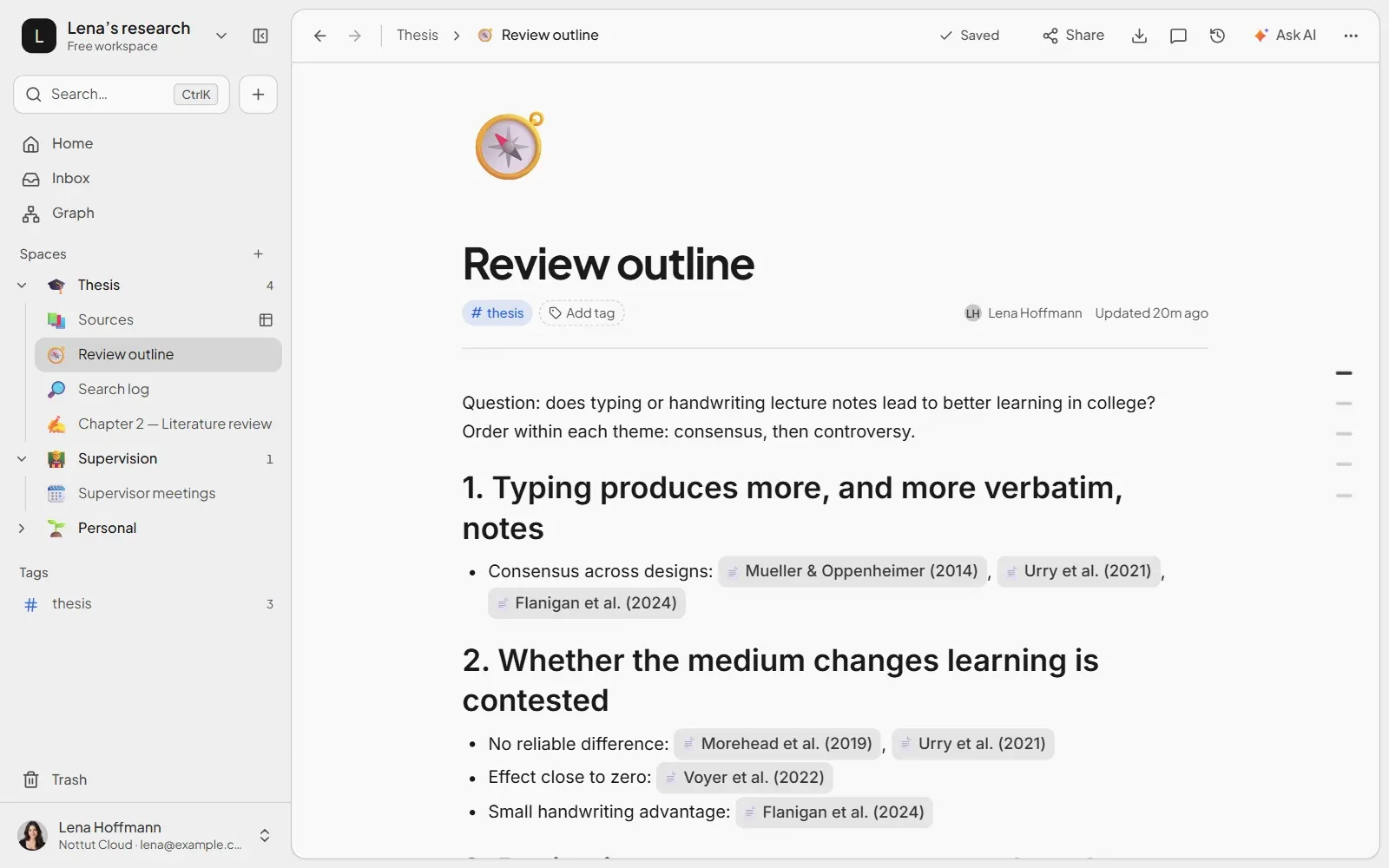
The outline: link the evidence. Write your outline as a page with one heading per theme. Under each claim, type [[ to link the sources that support it, so every claim can be traced back to its notes.
FAQ
What is the difference between a literature review and an annotated bibliography?
An annotated bibliography describes and evaluates each source separately, usually in alphabetical order. A literature review discusses sources together, grouped by theme or concept, to show what the research says as a whole.
What is the difference between a literature review and a systematic review?
A systematic review is a type of literature review with a predefined, reproducible method: a protocol written in advance (often registered), a documented search, explicit screening and appraisal, and full reporting, often following PRISMA 2020. Most literature reviews in course papers and theses are narrative reviews, with a method that is described but not fully reproducible.
How many sources should a literature review have?
There is no fixed number. Include the studies that answer your question, prioritizing the most important, recent and methodologically strong ones, and check with your assignment or supervisor for any expectations.
How do I start a literature review?
Start with a focused question and its boundaries, then run a logged search in two or more databases. Read two or three recent reviews on your topic first: their reference lists are the fastest way to find the key studies.
What is a gap in the literature?
A question the existing research has not answered well: a population that has not been studied, conflicting results nobody has explained, or a method that has not been tried. Your matrix shows gaps as empty or contradictory cells.
What is a literature review matrix?
A table with sources in rows and concepts in columns, such as design, sample, findings and themes. It turns a pile of notes into something you can compare, and it is the easiest way to move from summarizing to synthesizing.
Can I write a literature review in first person?
Usually yes in APA Style, which allows "I" and "we" to describe what you did, for example "I searched three databases." Check your instructor's or journal's preferences.
The short version
A literature review explains what research knows about a question, where it disagrees and what is missing. Define a focused question, search and screen with a log, take structured notes, build a matrix, and write by theme, from consensus to controversy to the gap. If you want the screening board, source notes, matrix and outline in one place, try Nottut free.
Related reading: Literature review examples and APA template · Note-taking app for researchers · How to take better notes
Sources
Guidance on literature reviews
- Arksey, H., & O'Malley, L. (2005). Scoping studies: Towards a methodological framework. International Journal of Social Research Methodology, 8(1), 19–32. doi.org/10.1080/1364557032000119616
- Grant, M. J., & Booth, A. (2009). A typology of reviews: An analysis of 14 review types and associated methodologies. Health Information & Libraries Journal, 26(2), 91–108. doi.org/10.1111/j.1471-1842.2009.00848.x
- Page, M. J., McKenzie, J. E., Bossuyt, P. M., et al. (2021). The PRISMA 2020 statement: An updated guideline for reporting systematic reviews. BMJ, 372, n71. doi.org/10.1136/bmj.n71
- Purdue Online Writing Lab. Writing a literature review. owl.purdue.edu
- Snyder, H. (2019). Literature review as a research methodology: An overview and guidelines. Journal of Business Research, 104, 333–339. doi.org/10.1016/j.jbusres.2019.07.039
- Torraco, R. J. (2005). Writing integrative literature reviews: Guidelines and examples. Human Resource Development Review, 4(3), 356–367. doi.org/10.1177/1534484305278283
- Tricco, A. C., Lillie, E., Zarin, W., et al. (2018). PRISMA extension for scoping reviews (PRISMA-ScR): Checklist and explanation. Annals of Internal Medicine, 169(7), 467–473. doi.org/10.7326/M18-0850
- University of North Carolina at Chapel Hill Writing Center. Literature reviews. writingcenter.unc.edu
- University of Southern California Libraries. The literature review. Organizing Your Social Sciences Research Paper. libguides.usc.edu
- University of Wisconsin–Madison Libraries. Literature reviews in the sciences, Lesson 3. learn.library.wisc.edu
- Webster, J., & Watson, R. T. (2002). Analyzing the past to prepare for the future: Writing a literature review. MIS Quarterly, 26(2), xiii–xxiii. doi.org/10.2307/4132319
- Wohlin, C. (2014). Guidelines for snowballing in systematic literature studies and a replication in software engineering. Proceedings of the 18th International Conference on Evaluation and Assessment in Software Engineering, 1–10. doi.org/10.1145/2601248.2601268
Studies in the worked example
- Carter, S. P., Greenberg, K., & Walker, M. S. (2017). The impact of computer usage on academic performance: Evidence from a randomized trial at the United States Military Academy. Economics of Education Review, 56, 118–132. doi.org/10.1016/j.econedurev.2016.12.005
- Flanigan, A. E., Wheeler, J., Colliot, T., Lu, J., & Kiewra, K. A. (2024). Typed versus handwritten lecture notes and college student achievement: A meta-analysis. Educational Psychology Review, 36, Article 78. doi.org/10.1007/s10648-024-09914-w
- Luo, L., Kiewra, K. A., Flanigan, A. E., & Peteranetz, M. S. (2018). Laptop versus longhand note taking: Effects on lecture notes and achievement. Instructional Science, 46(6), 947–971. doi.org/10.1007/s11251-018-9458-0
- Morehead, K., Dunlosky, J., & Rawson, K. A. (2019). How much mightier is the pen than the keyboard for note-taking? A replication and extension of Mueller and Oppenheimer (2014). Educational Psychology Review, 31(3), 753–780. doi.org/10.1007/s10648-019-09468-2
- Mueller, P. A., & Oppenheimer, D. M. (2014). The pen is mightier than the keyboard: Advantages of longhand over laptop note taking. Psychological Science, 25(6), 1159–1168. doi.org/10.1177/0956797614524581
- Urry, H. L., Crittle, C. S., Floerke, V. A., et al. (2021). Don't ditch the laptop just yet: A direct replication of Mueller and Oppenheimer's (2014) Study 1 plus mini meta-analyses across similar studies. Psychological Science, 32(3), 326–339. doi.org/10.1177/0956797620965541
- Voyer, D., Ronis, S. T., & Byers, N. (2022). The effect of notetaking method on academic performance: A systematic review and meta-analysis. Contemporary Educational Psychology, 68, 102025. doi.org/10.1016/j.cedpsych.2021.102025