Literature Review Examples: 3 Annotated Samples + Template
Three annotated literature review examples built on real, cited studies: a thematic section, a synthesis of conflicting findings and a conclusion, plus an APA 7 template.
A literature review is easier to write once you have seen a good one taken apart. Below are three short examples from one review about how students learn from lectures: a section organized by theme, a section that reconciles studies that disagree, and a conclusion. Every study cited is real, and every number matches its source. After each example, a table shows what the writing is doing and why.
At the end you will find an APA 7 template, the matrix the examples were written from, and how to set up the same workflow in Nottut.
Table of contents
- What is a literature review?
- Example 1: A section organized by theme
- Example 2: Reconciling studies that disagree
- Example 3: A literature review conclusion
- From matrix to paragraph: how the examples were built
- Ways to organize a literature review
- Literature review template (APA 7)
- Common mistakes
- Write your literature review in Nottut
- FAQ
What is a literature review?
A literature review brings together the published research on a question and discusses the studies in relation to each other: what they found, where they agree, where they conflict, and what is still unknown (Purdue OWL; UNC Writing Center). It can be a paper of its own, the opening section of a journal article, or a chapter of a thesis.
The key word is synthesis. A summary recaps one source at a time; a synthesis reorganizes what several sources say around your question (UNC Writing Center). Purdue OWL offers a quick test: if every paragraph cites just one source, you are probably summarizing.
Most reviews students write are narrative literature reviews. A systematic review is a different method: it aims for an exhaustive search, appraises every included study, and often follows published guidelines (Grant & Booth, 2009).
For the whole process, from a focused question and a logged search to screening sources and building a literature matrix, see our step-by-step guide on how to write a literature review.
Example 1: A section organized by theme
This section makes one argument, that recalling material beats rereading it, and uses each study as evidence for a part of that argument.
Retrieval Practice and Long-Term Retention
Retrieval practice, recalling information from memory rather than rereading it, improves long-term retention. In a widely cited experiment, students who read a prose passage once and then tried to recall it three times remembered 61% of it a week later, against 40% for students who read it four times, although rereading had produced better recall after five minutes (Roediger & Karpicke, 2006). The benefit depends on continued retrieval: when students stopped practicing word pairs after one correct recall, only about a third were remembered a week later, compared with about 80% when they kept retrieving them (Karpicke & Roediger, 2008).
Retrieval practice also holds up against strategies often taught as deeper processing. With study time held constant, students who practiced retrieval scored 67% on a final test a week later, compared with 45% for students who built concept maps (Karpicke & Blunt, 2011). Syntheses across many studies point the same way. A meta-analysis found that practice tests outperformed restudying and the other comparison conditions (Adesope et al., 2017), and a review of ten common study techniques rated practice testing as one of only two with high utility, alongside distributed practice (Dunlosky et al., 2013).
The timing of practice matters too. Across 317 experiments, spaced study outperformed massed study in all but 12 of 271 comparisons (Cepeda et al., 2006), and the best gap between study sessions grew with the delay until the final test (Cepeda et al., 2008). Most of the experiments reviewed here, however, used short laboratory materials such as prose passages, word pairs, and obscure facts. Whether the benefits hold in large university lectures, where attention and timing are harder to control, is the question this study addresses.
What this example does
- Opens with a claim: "Retrieval practice … improves long-term retention." The reader knows what the paragraph argues before the evidence arrives.
- Gives the numbers: "61% … against 40%." A result the reader can check beats "research shows".
- Adds a condition: "The benefit depends on continued retrieval." Each study adds something new instead of repeating the last one.
- Moves from single studies to syntheses: "Syntheses across many studies point the same way." Meta-analyses and reviews show the pattern is not one lab's result.
- Ends on a limitation that sets up the gap: "Most of the experiments reviewed here … used short laboratory materials." The review earns the study that follows it.
Example 2: Reconciling studies that disagree
Reviews get harder when studies conflict. This section keeps the original finding, reports the replications fairly, and uses meta-analyses to size the effect before drawing a conclusion.
Laptops, Longhand, and What Happens Afterward
Whether students should take lecture notes by hand or on a laptop has been debated since Mueller and Oppenheimer (2014) reported that, across three studies, students who typed their notes did worse on conceptual questions, apparently because they transcribed lectures more word for word. Direct replications have not reproduced the performance difference. Morehead et al. (2019) found no consistent differences between laptop, e-writer, and longhand groups, and in a replication with 142 students, laptop users again took longer and more verbatim notes but scored no differently on the quiz (Urry et al., 2021).
Meta-analyses place the effect between zero and small. Synthesizing 24 studies of college students, Flanigan et al. (2024) found a small advantage for handwriting (g = 0.25) that was larger when students reviewed their notes (g = 0.42), while typed notes were much longer (g = 0.92). Taken together, the evidence suggests that the medium matters less than what students do with their notes afterward. The clearer risk of laptops is distraction: in a randomized trial at the United States Military Academy, allowing computers in class lowered final exam scores by about 0.2 standard deviations (Carter et al., 2017).
What this example does
- States the original claim and its explanation: "Mueller and Oppenheimer (2014) reported that …" A fair review starts from the strongest version of the finding.
- Reports what replicated and what did not: "laptop users again took longer and more verbatim notes but scored no differently." It separates the part that held up from the part that did not.
- Sizes the effect with meta-analyses: "g = 0.25 … g = 0.42 … g = 0.92." Effect sizes turn a yes-or-no argument into "how much".
- Offers an interpretation that fits all of it: "the medium matters less than what students do with their notes afterward." This is synthesis: a claim no single study makes on its own.
- Keeps the practical risk in view: "allowing computers in class lowered final exam scores." A field experiment answers a different question than a lab study.
Example 3: A literature review conclusion
A conclusion says what the most important studies contributed, judges the state of the evidence, including its gaps and inconsistencies, and connects the topic to the larger question, which in a thesis is usually your own study (UW–Madison Libraries; Purdue OWL).
Conclusion
The studies reviewed in this chapter agree on three points. First, recalling material from memory strengthens long-term retention more than rereading it, even though rereading feels more effective at the time. Second, the benefit depends on retrieval that continues after the first success and is spread out over time. Third, the medium used to take notes appears to matter less than whether those notes are later reviewed. Two limitations run through this evidence: most of the experiments used short laboratory materials, and most measured retention no more than a week after learning. The next chapter therefore tests short retrieval quizzes during regular lectures and measures what students remember at the end of the course.
What this example does
- Summarizes by theme, not by study: "agree on three points." The conclusion restates the argument, not the reading list.
- Names the limits of the evidence: "Two limitations run through this evidence." Honest limits make the gap believable.
- Hands over to the study: "The next chapter therefore tests …" The review's job is to justify the question that comes next.
From matrix to paragraph: how the examples were built
The examples were written from a literature review matrix: one row per study, one column per thing to compare. The idea is well tested. Webster and Watson (2002) recommended filling in a concept matrix while you read, with articles as rows and concepts as columns, so that the review is organized around concepts rather than authors, and Garrard's Matrix Method builds a whole review process around a similar table (Webster & Watson, 2002; Garrard, 2022). The figure below shows three rows of that matrix and the sentences they became in Example 1.
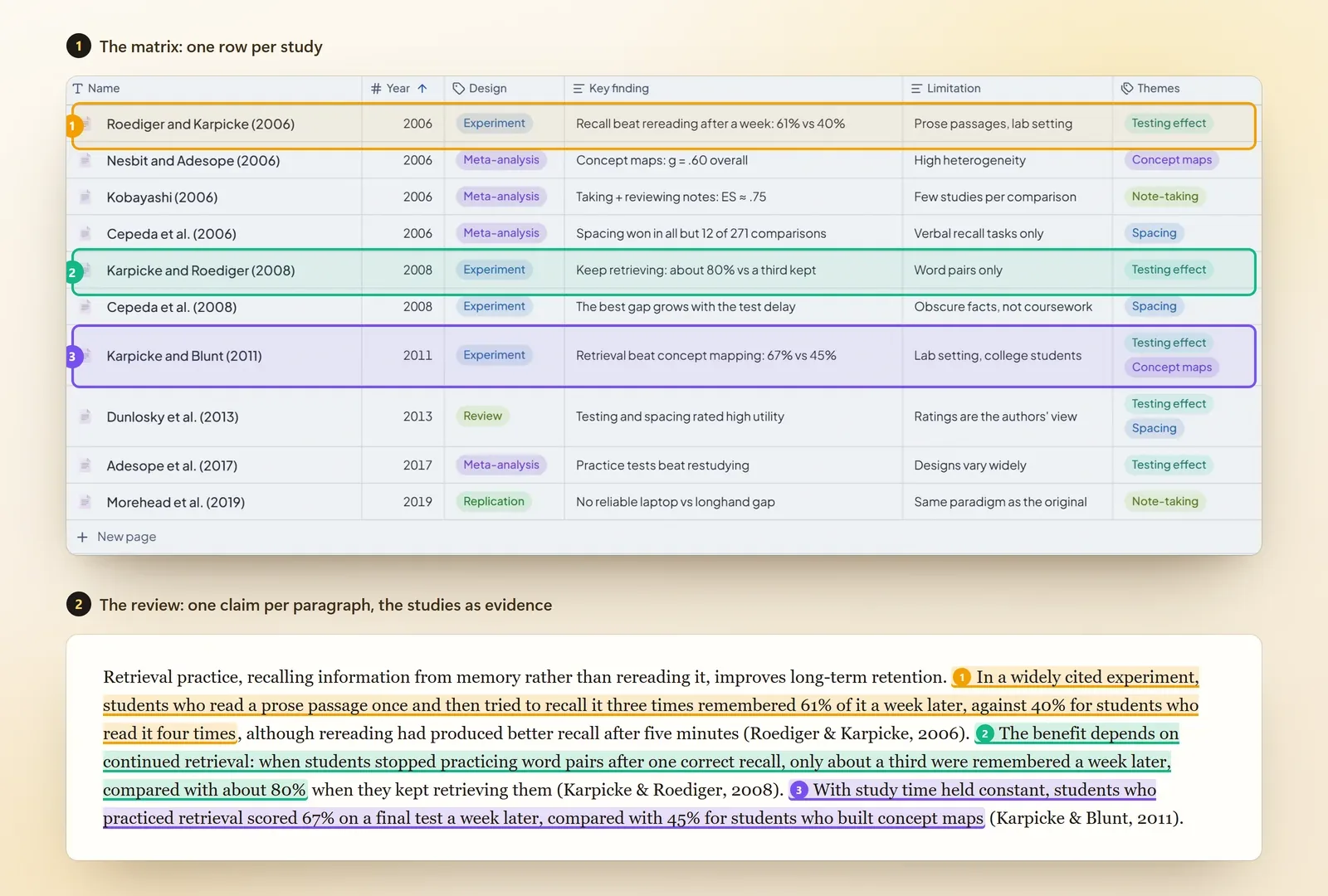
Two things make the matrix worth the effort. Comparing studies side by side turns "study after study" into claims that several studies support, which is what synthesis is. And empty or repetitive cells show you the gap: here, the Limitation column kept saying "lab setting" and "word pairs", which is where the section's final sentence comes from.
Ways to organize a literature review
Writing guides name four common ways to organize a review (Purdue OWL; UNC Writing Center; USC Libraries). The easiest way to choose is to see the same studies arranged each way. Here is the review behind the examples, four times:
- Thematic: Retrieval beats rereading · Retrieval versus concept mapping · Spacing and timing. Choose it when the studies answer several sub-questions. USC calls this the most common approach in the social and behavioral sciences.
- Chronological: 2006–2008, early experiments · 2011, a head-to-head with concept mapping · 2013–2017, large syntheses. Choose it when the field changed its mind over time, as it did about laptops in Example 2.
- Methodological: Laboratory experiments · Meta-analyses and reviews · Field experiments. Choose it when differences in method explain why results differ.
- Theoretical: One section per explanation the studies test. Choose it when the debate is about why an effect happens, not whether it does.
Most reviews mix patterns. Example 1 is thematic, and Example 2 tells a short chronological story inside its theme. Within a theme, moving from where studies agree to where they disagree reads naturally (UW–Madison Libraries).
Literature review template (APA 7)
A literature review in APA style is usually a student paper with a title page, an introduction, a body organized by theme, a conclusion and a reference list. Copy this outline into your document or into a Nottut page, and replace each bracket.
Title page
  [Title] · [Your name] · [Department, university] · [Course] · [Instructor] · [Due date]

[Title, repeated in bold at the top of the first page]
  Introduction, with no heading: the question, and why it matters
  The scope: years covered, databases searched, what was included
  One sentence on how the review is organized

[Theme 1, written as a claim]
  The studies that support it, with the numbers that matter
  Where they disagree, and why

[Theme 2, written as a claim]

[Theme 3, written as a claim]

Conclusion
  What the studies agree on
  The limits of the evidence
  The gap your study or paper addresses

References
APA 7 rules for a student paper (APA Style):
| Element | Rule |
|---|---|
| Title page | Title in bold, then your name, affiliation, course number and name, instructor, due date and the page number. No running head unless your instructor asks for one. |
| Spacing and margins | Double-space everything, references included, with 1-inch margins on every side. |
| Headings | Level 1: centered, bold, title case. Level 2: flush left, bold, title case. Level 3: flush left, bold italic, title case. Don't label the introduction "Introduction", and don't number headings. |
| References | A new page titled References, entries in alphabetical order with a hanging indent. |
APA also publishes a literature review student paper template (DOCX) on its sample papers page.
Common mistakes
- One study per paragraph. "Smith (2019) found … Jones (2020) found …" is an annotated bibliography, not a review. Group studies by what they show.
- "Research shows" without the research. Name the study, and give the number that matters.
- Leaving out studies that disagree. Readers who know the field will notice, and the conflict is often the most interesting part (Example 2).
- Claiming more than your search supports. "All studies agree" is a claim about a systematic search. A narrative review can say "the studies reviewed here".
- No gap. A review that ends without saying what is not yet known leaves the reader asking why your study is needed.
Write your literature review in Nottut
The examples above come from a demo PhD workspace in Nottut, built around the same four steps. (The researcher walkthrough covers the whole workspace.)
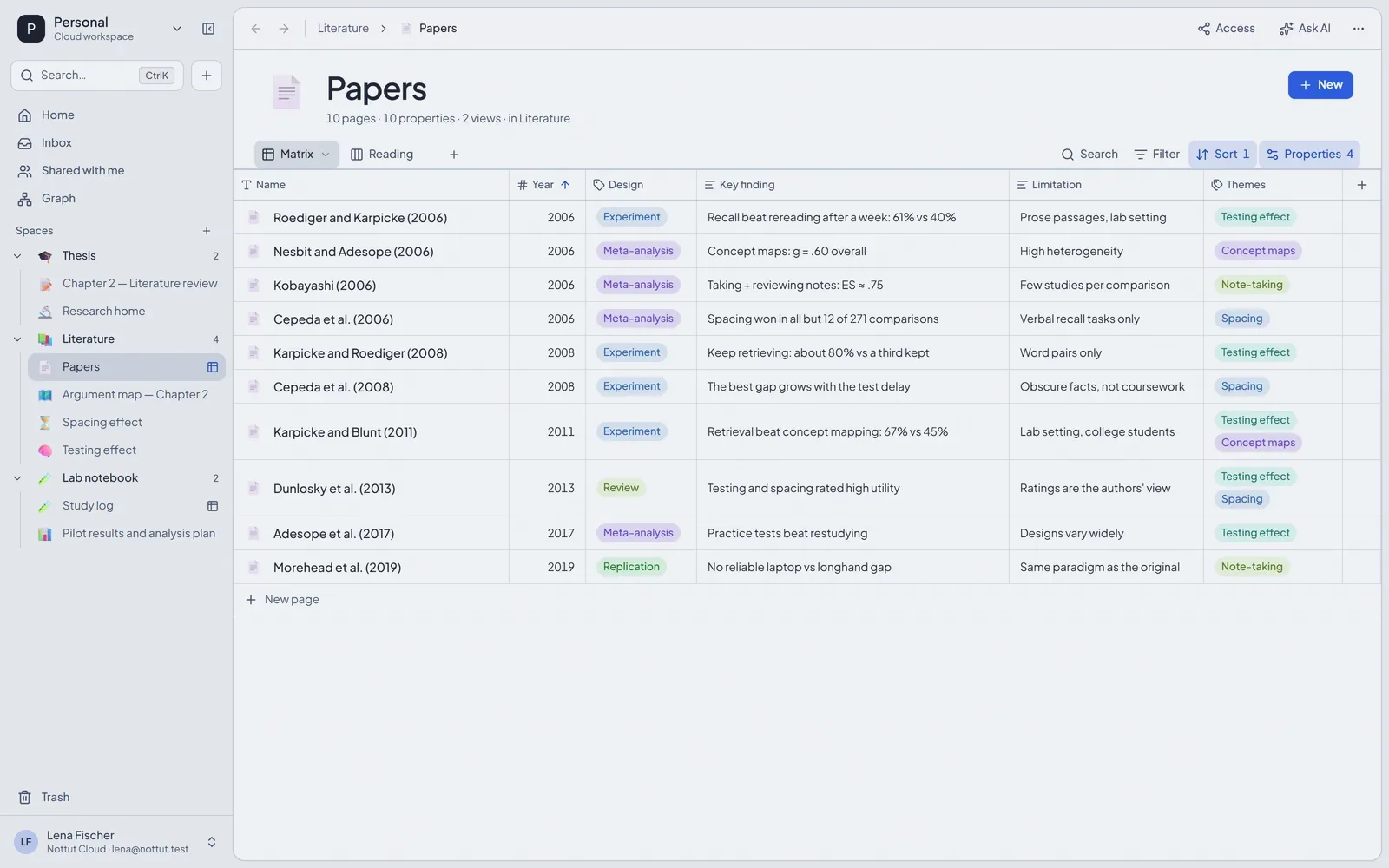
1. Build the matrix as a database. One row per study, with properties for year, design, key finding, limitation and themes. Sort it by year, or add a board view to track what you have read.
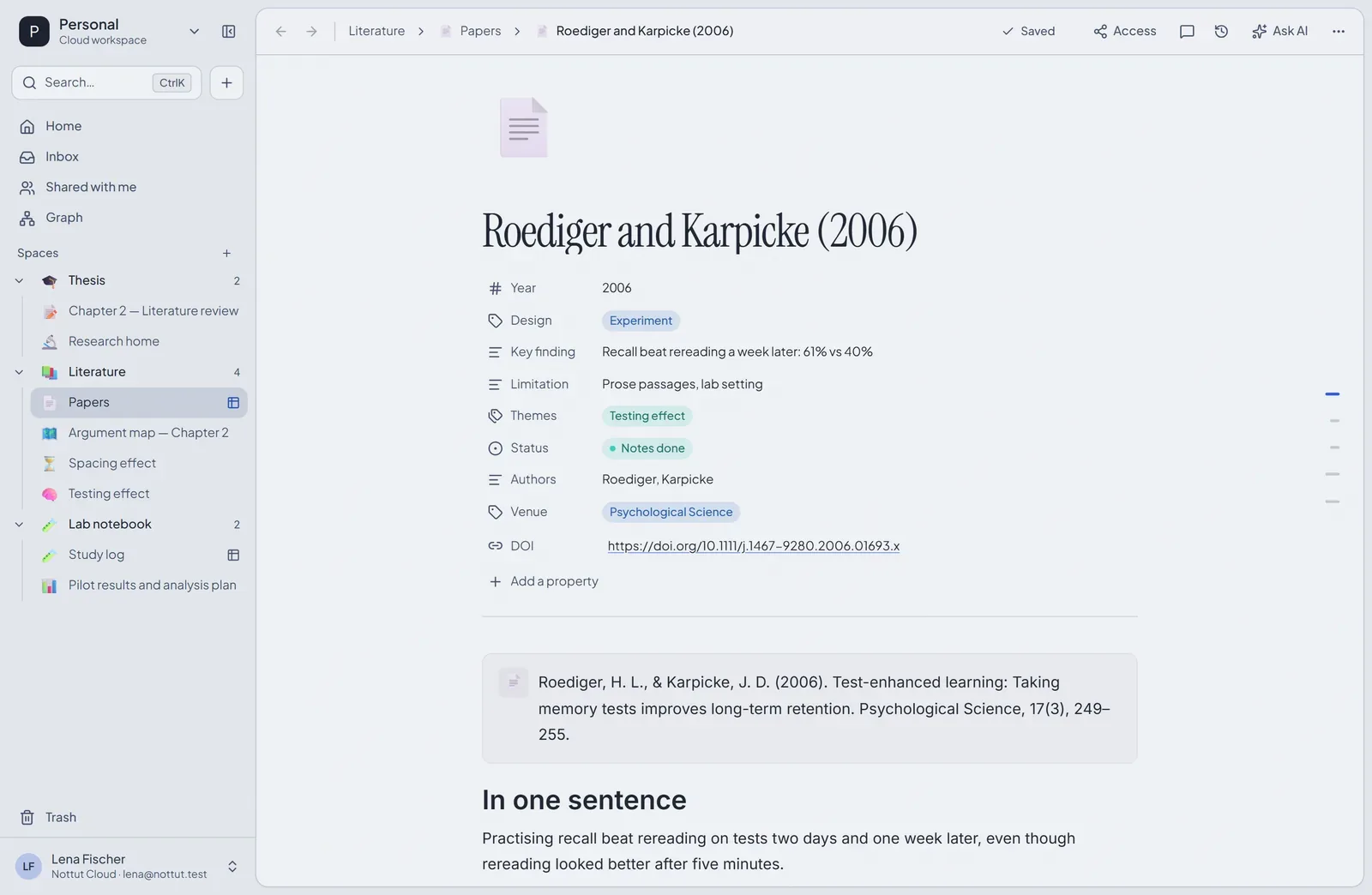
2. Give each study its own page. Every row opens as a page, with its properties at the top and your notes below: the full citation, a one-sentence summary, method and result, and why it matters for your question.
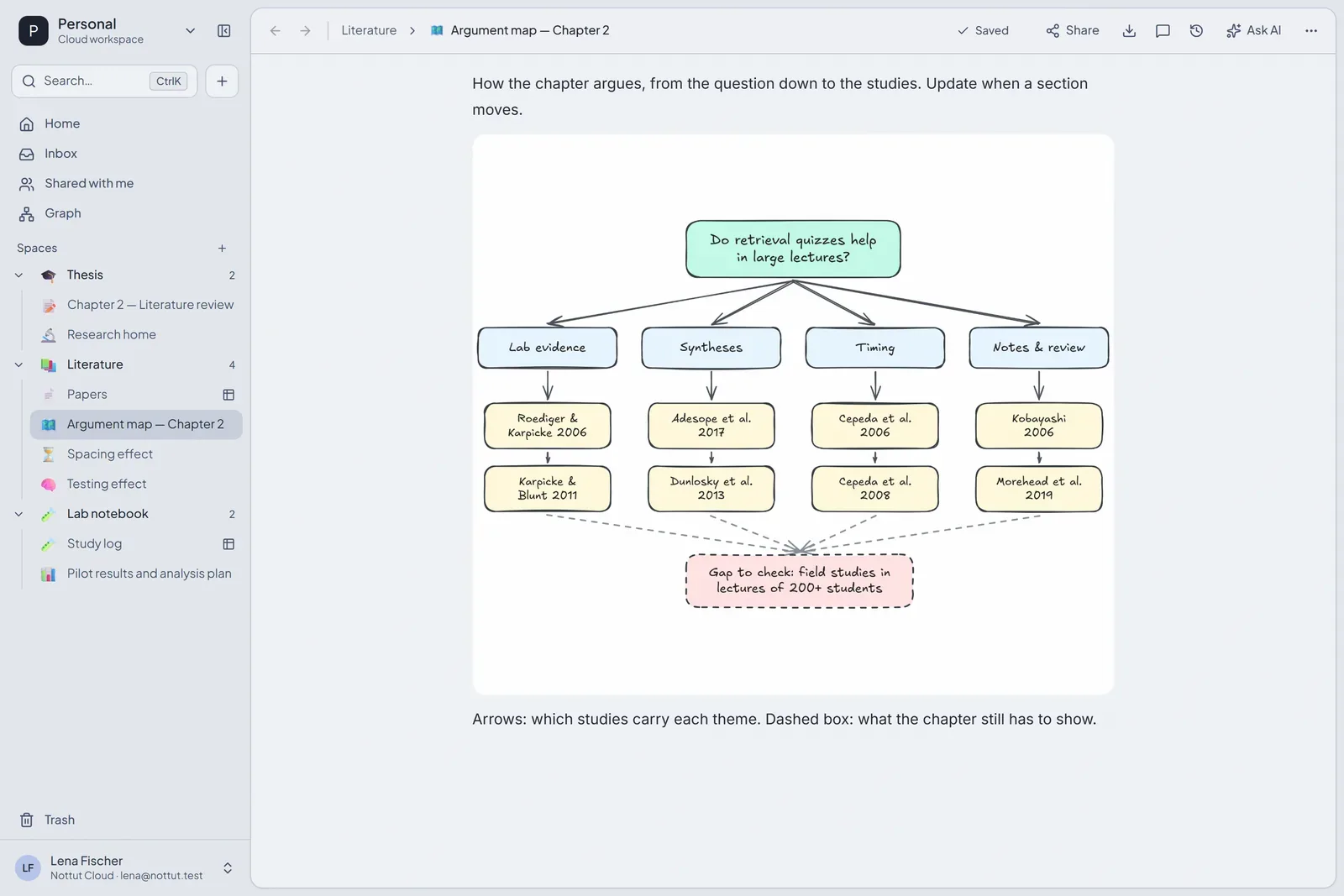
3. Map the argument before you write. A drawing block (/draw) holds the structure: the question, the themes under it, the studies under each theme, and the gap.
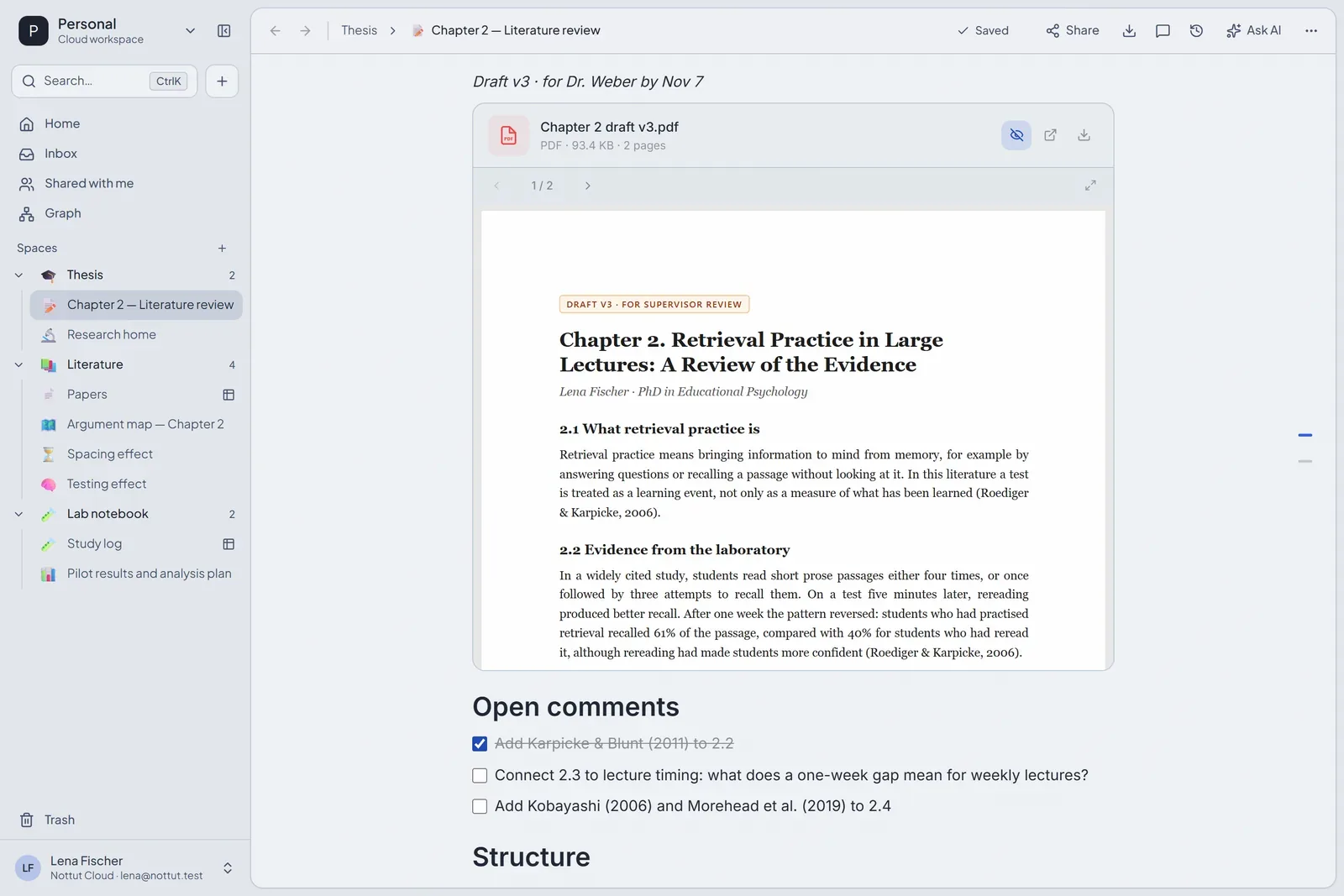
4. Draft, then export. Write the sections in a page and export to Markdown, HTML or PDF, or keep the PDF you send your supervisor in the page, with their comments as to-dos underneath. Nottut does not format citations, so use your reference manager's plugin for the final reference list.
FAQ
What is the difference between a literature review and a systematic review?
A literature review, often called a narrative review, brings together and evaluates research on a topic; it may or may not search comprehensively or assess the quality of each study. A systematic review follows an explicit method: it aims for an exhaustive search, appraises every included study and often follows published guidelines (Grant & Booth, 2009). A systematic review sometimes combines the results statistically in a meta-analysis.
How long should a literature review be?
There is no fixed length. Follow your assignment, department or journal. What matters more is coverage: the main positions on your question, the strongest studies on each side, and the gap.
What is a literature review matrix?
A table with one row per study and one column per thing you want to compare, such as year, design, sample, key finding and limitation. Writing from a matrix makes it easier to group studies by what they show instead of summarizing them one at a time.
Can I use these examples in my own work?
Use them as models for structure and moves, not as text to copy. Write your own synthesis and cite the original studies, not this page.
The short version
A good literature review argues a point and uses studies as evidence: claims first, numbers from the studies, disagreements reconciled, and a gap at the end. Build a matrix first and the paragraphs are easier to write. Create a free account to build your matrix in Nottut.
Related reading: Nottut for researchers · How to take better notes · Active recall and spaced repetition
Sources
Studies cited in the examples
- Adesope, O. O., Trevisan, D. A., & Sundararajan, N. (2017). Rethinking the use of tests: A meta-analysis of practice testing. Review of Educational Research, 87(3), 659–701. doi.org/10.3102/0034654316689306
- Carter, S. P., Greenberg, K., & Walker, M. S. (2017). The impact of computer usage on academic performance: Evidence from a randomized trial at the United States Military Academy. Economics of Education Review, 56, 118–132. doi.org/10.1016/j.econedurev.2016.12.005
- Cepeda, N. J., Pashler, H., Vul, E., Wixted, J. T., & Rohrer, D. (2006). Distributed practice in verbal recall tasks: A review and quantitative synthesis. Psychological Bulletin, 132(3), 354–380. doi.org/10.1037/0033-2909.132.3.354
- Cepeda, N. J., Vul, E., Rohrer, D., Wixted, J. T., & Pashler, H. (2008). Spacing effects in learning: A temporal ridgeline of optimal retention. Psychological Science, 19(11), 1095–1102. doi.org/10.1111/j.1467-9280.2008.02209.x
- Dunlosky, J., Rawson, K. A., Marsh, E. J., Nathan, M. J., & Willingham, D. T. (2013). Improving students' learning with effective learning techniques. Psychological Science in the Public Interest, 14(1), 4–58. doi.org/10.1177/1529100612453266
- Flanigan, A. E., Wheeler, J., Colliot, T., Lu, J., & Kiewra, K. A. (2024). Typed versus handwritten lecture notes and college student achievement: A meta-analysis. Educational Psychology Review, 36, Article 78. doi.org/10.1007/s10648-024-09914-w
- Karpicke, J. D., & Blunt, J. R. (2011). Retrieval practice produces more learning than elaborative studying with concept mapping. Science, 331(6018), 772–775. doi.org/10.1126/science.1199327
- Karpicke, J. D., & Roediger, H. L. (2008). The critical importance of retrieval for learning. Science, 319(5865), 966–968. doi.org/10.1126/science.1152408
- Morehead, K., Dunlosky, J., & Rawson, K. A. (2019). How much mightier is the pen than the keyboard for note-taking? A replication and extension of Mueller and Oppenheimer (2014). Educational Psychology Review, 31(3), 753–780. doi.org/10.1007/s10648-019-09468-2
- Mueller, P. A., & Oppenheimer, D. M. (2014). The pen is mightier than the keyboard: Advantages of longhand over laptop note taking. Psychological Science, 25(6), 1159–1168. doi.org/10.1177/0956797614524581
- Roediger, H. L., & Karpicke, J. D. (2006). Test-enhanced learning: Taking memory tests improves long-term retention. Psychological Science, 17(3), 249–255. doi.org/10.1111/j.1467-9280.2006.01693.x
- Urry, H. L., Crittle, C. S., Floerke, V. A., Leonard, M. Z., Perry, C. S., Akdilek, N., … Zarrow, J. E. (2021). Don't ditch the laptop just yet: A direct replication of Mueller and Oppenheimer's (2014) Study 1 plus mini meta-analyses across similar studies. Psychological Science, 32(3), 326–339. doi.org/10.1177/0956797620965541
Guidance on writing literature reviews
- American Psychological Association. Paper format; Sample papers. APA Style. apastyle.apa.org
- Garrard, J. (2022). Health sciences literature review made easy: The matrix method (6th ed.). Jones & Bartlett Learning. jblearning.com
- Grant, M. J., & Booth, A. (2009). A typology of reviews: An analysis of 14 review types and associated methodologies. Health Information & Libraries Journal, 26(2), 91–108. doi.org/10.1111/j.1471-1842.2009.00848.x
- Purdue Online Writing Lab. Writing a literature review. owl.purdue.edu
- University of North Carolina at Chapel Hill Writing Center. Literature reviews. writingcenter.unc.edu
- University of Southern California Libraries. The literature review. Organizing Your Social Sciences Research Paper. libguides.usc.edu
- University of Wisconsin–Madison Libraries. Literature reviews in the sciences, Lesson 3. learn.library.wisc.edu
- Webster, J., & Watson, R. T. (2002). Analyzing the past to prepare for the future: Writing a literature review. MIS Quarterly, 26(2), xiii–xxiii. doi.org/10.2307/4132319