Study Techniques That Actually Work, Ranked by Evidence
The 10 most-studied study techniques and methods, ranked by research: what works, what only feels productive, and how to use each one in your notes.
The study techniques with the strongest evidence are practice testing (quizzing yourself) and spaced practice (spreading study over days). Interleaving, self-explanation and elaborative interrogation come next. The most popular techniques, rereading, highlighting and summarizing, do the least. Pomodoro, the Feynman technique and mind maps are ways to organize those techniques rather than techniques of their own.
This guide ranks the ten study techniques and methods researchers have tested most, with the actual numbers, including the cases where a technique does not help. Then it turns them into a weekly routine you can run in your notes.
Key takeaways
- Test yourself, then check the answer. Practice tests beat rereading in 81% of 159 comparisons, and the gain almost doubles when you check your answers.
- Space it out. Across 271 comparisons, spreading the same study time over several sessions raised recall from 37% to 47%.
- Mix problem types you tend to confuse. In a 7th-grade maths class, mixed practice scored 74% a month later against 42% for practicing one type at a time.
- Rereading feels like learning and isn't much of it. Eighty-four percent of students in one survey reread; 11% quizzed themselves.
- Named methods are packaging. Pomodoro, Feynman and mind maps help only as far as they get you to retrieve, explain or space.
Table of contents
- Study techniques ranked by the evidence
- How the ranking works
- Practice testing: the strongest technique
- Spaced practice: the other top-rated technique
- Interleaving: mix problem types you confuse
- Self-explanation and elaborative interrogation
- The popular techniques that underperform, and how to fix them
- Pomodoro, Feynman, mind maps and other named methods
- Learning styles: a myth to skip
- Why the best techniques feel worse
- Which technique to use for what you're studying
- A weekly study routine
- How to use these study techniques in Nottut
- FAQ
Study techniques ranked by the evidence
In 2013 five cognitive psychologists reviewed ten techniques students can use on their own and rated each one's usefulness as high, moderate or low. In 2021 a meta-analysis pooled 242 studies of the same ten techniques, with 169,179 participants, and measured how much each one helped.
| Technique | Rating (Dunlosky et al.) | Effect size (d) |
|---|---|---|
| Practice testing | High | 0.74 |
| Distributed (spaced) practice | High | 0.85 |
| Elaborative interrogation | Moderate | 0.56 |
| Self-explanation | Moderate | 0.54 |
| Interleaved practice | Moderate | 0.47 |
| Summarization | Low | 0.44 |
| Highlighting and underlining | Low | 0.44 |
| Keyword mnemonic | Low | 0.50 |
| Imagery for text | Low | 0.56 |
| Rereading | Low | 0.47 |
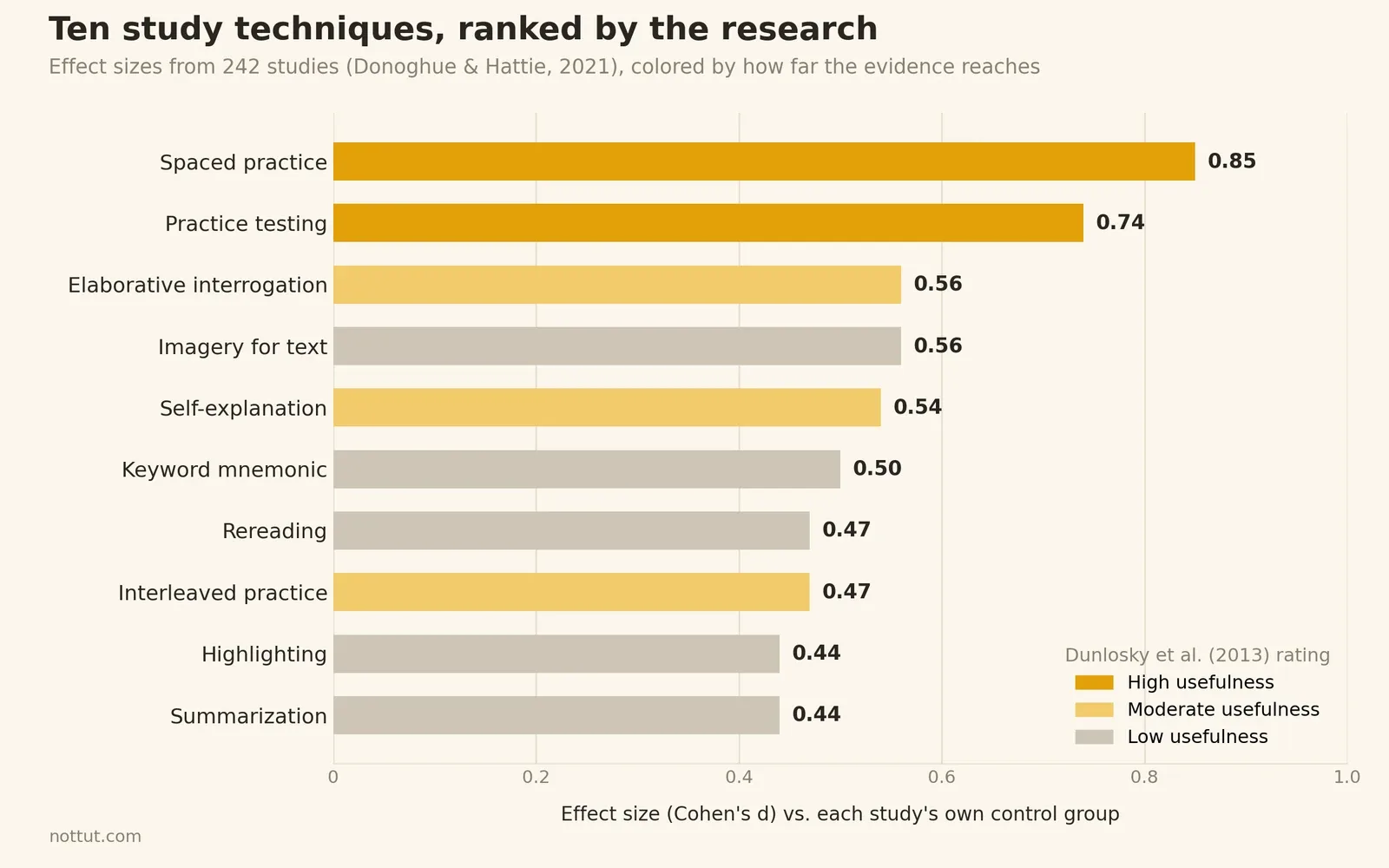
An effect size of 0.5 means the average student using the technique did better than roughly 69% of the students in the comparison group. The two sources don't always agree: imagery scores as high as elaborative interrogation in the meta-analysis but is rated low by Dunlosky. The next section explains why, and why the ratings are the better guide.
How the ranking works
The ratings measure how far a result reaches. Dunlosky and colleagues rated a technique high only when it worked across different learners, materials, kinds of test, and real classrooms. A technique that works for memorizing word lists in a lab but was never tried with long texts or in schools gets a lower rating, even if its lab results look big. That is why imagery, which works mainly for material that is easy to picture, is rated low despite its 0.56.
The effect sizes measure how much a technique beats doing less. Each study in the 2021 meta-analysis compared a technique with its own control, often reading the material once. So rereading's 0.47 means rereading beats not rereading. It does not mean rereading comes close to practice testing, which in direct comparisons wins clearly (see below).
The evidence has limits. Three quarters of the tests in the meta-analysis came within a day of studying, 93% measured surface learning such as recall of facts, and it includes no study published after 2014. Newer meta-analyses of individual techniques, cited in each section below, fill some of those gaps, and they agree on the top of the ranking.
Practice testing: the strongest technique
Practice testing means retrieving information from memory: answering questions, doing practice problems, or writing down everything you remember about a topic on a blank page. It is the technique behind active recall and flashcards.
- It beats rereading, but not straight away. In one classic experiment, students who reread a passage four times recalled 83% after five minutes, against 71% for those who read it once and then tested themselves three times. A week later the order had flipped: 61% for the testers, 40% for the rereaders.
- It works in real classes. A 2021 meta-analysis of 222 classroom studies with 48,478 students found quizzing raised achievement with an effect size of 0.50.
- Checking the answer matters. Across 159 lab comparisons, testing beat restudying with an effect of 0.73 when students saw the correct answer afterward and 0.39 when they didn't. When students recalled half or less of the material and got no feedback, the benefit disappeared (0.03).
- It beats making concept maps. Students who practiced recalling a science text scored 67% on a test a week later, against 45% for students who spent the same time drawing a concept map with the text open.
- Don't drop what you "know". Students who kept testing themselves on word pairs they had already recalled once remembered about 80% a week later. When those items were dropped after the first correct answer, recall fell to about a third.
How to do it: close your notes and answer from memory before you look; check every answer; keep items in your practice until you have recalled them correctly at least three times; and mix question types. Our active recall guide covers the details.
Spaced practice: the other top-rated technique
Spaced (or distributed) practice means studying the same material in several shorter sessions spread over days instead of in one long block.
- Same time, more retained. A review of 271 comparisons found that spacing out the same study time raised average recall from 36.7% to 47.3%. Only 12 of the 271 comparisons showed no benefit.
- The best gap depends on when you need it. In a study of 1,354 people, the best gap between two study sessions was about 20–40% of the time until the test when the test was a week away, falling to about 5–10% for a test a year away. With the best gap, final recall was 64% higher than reviewing on the same day.
- Too late beats too early. A review that comes later than ideal costs much less than one that comes too soon.
- The exact schedule matters less than spacing itself. A 2021 meta-analysis found spacing retrieval sessions apart helps a lot (0.74), but expanding gaps (1, 3, 7 days…) did no better than equal gaps. Methods like 2-3-5-7 are fine, but not a scientific optimum.
How to do it: start reviewing a topic the day after you learn it, then return to it a few days later and again the week after, and keep revisiting older topics until the exam. Cramming can pass tomorrow's test; spacing is what is left a month later.
Interleaving: mix problem types you confuse
Interleaving means mixing different kinds of problems or examples in one session instead of practicing one kind at a time (blocking).
- In classrooms: 7th graders who worked through mixed maths assignments scored 72% on a surprise test, against 38% for blocked practice. In another class the gap grew with time: 80% vs 64% a day after the last review, and 74% vs 42% a month later.
- It feels worse while it works better. In a lab study, students scored higher during blocked practice (89% vs 60%), but a week later the mixed group scored 63% against 20%.
- It depends on the material. A meta-analysis of 59 studies found an overall benefit of 0.42: 0.67 for learning to tell paintings apart and 0.34 for maths. For word material, blocking was better (−0.39), and for expository texts the difference was not significant.
How to do it: once you have learned each type of problem on its own, mix them in practice sets, especially the types you tend to confuse, like similar formulas, related diseases or painters with similar styles. Interleaving is about choosing the right method for a problem, so it matters most in maths, physics and anything with categories to tell apart.
Self-explanation and elaborative interrogation
Both are ways of explaining what you read to yourself, and both are rated moderate.
Self-explanation means explaining how new information connects to what you already know, or explaining each step while you solve a problem. A meta-analysis of 64 studies found an average benefit of 0.55 when students were prompted to explain. It works across ages, subjects and kinds of test, including applying ideas to new problems. The cost is time: students who explain can take 30% to 100% longer. And the explanation has to be an explanation, not a paraphrase: weaker students often restate the text instead of explaining it.
Elaborative interrogation means asking why a fact is true. In a classic study, students who answered a "why?" question about each fact remembered about 72% of the facts, against about 37% for students who just read them. It costs little extra time and works best when you already know something about the topic.
How to do it: under each key idea, write "Why is this true?" or "How does this connect to…?" and answer in your own words. For problems, write one line after each step saying why you took it.
The popular techniques that underperform, and how to fix them
Rereading, highlighting, notes, outlines and flashcards are what most students use. None is useless; each is easy to do in a way that feels productive and teaches little. A 2018 review of these five strategies found a fix for each:
- Rereading: reading it again feels fluent, and fluency feels like knowing. Fix: space your rereading out and test yourself between readings.
- Highlighting: most students mark too much, or the wrong things. In an old study, the amount students highlighted was, if anything, linked to worse scores, and one study found highlighting hurt questions that required inference. Fix: read the whole section first, then highlight only the main points, following the text's structure.
- Notes: copying the lecture word for word and never reviewing it helps little. Fix: review your notes before the exam, and turn them into questions. Our guide to taking better notes covers this.
- Outlines: building one from scratch without following how the text is organized. Fix: find the main points after reading the whole section and follow the text's structure, or fill in a skeleton outline.
- Flashcards: dropping a card after one correct answer. Fix: recall each card correctly at least three times before you drop it.
Summarizing is rated low as well: it helps students who are already good at it, and most need training first. If you summarize, write the summary from memory and then compare it with the source, which turns it into practice testing.
Two other techniques in the table are narrow tools. The keyword mnemonic (linking a new word to a vivid image of a familiar word) helps with vocabulary that is easy to picture, but it is slow to set up, and in one comparison it did no better than practice testing and worse a week later. Imagery for text (picturing what you read) helps only with material that is easy to visualize.
Pomodoro, Feynman, mind maps and other named methods
Most "top 10 study methods" lists are made of named methods. Here is what the research says about each.
- Pomodoro technique (25 minutes of work, 5-minute break). Three small trials have tested fixed breaks against breaks students chose themselves. None found better learning: in the one with a reading test, comprehension scores were 12.93 with fixed breaks and 12.23 with self-chosen breaks, not a significant difference. Their findings on fatigue and motivation point in opposite directions. Use it if a timer helps you start, and fill the 25 minutes with practice testing.
- Feynman technique (explain a topic simply, find the gaps, go back to the source). Only one small school study has tested it directly. The evidence for its parts is solid, though: explaining (self-explanation, 0.55) and studying as if you'll have to teach it. In one meta-analysis, teaching others after preparing to teach helped (0.48), but only when students had studied expecting to teach. We found no primary source showing that Richard Feynman set out this four-step method himself.
- Mind maps. The study most often cited for "mind maps boost memory" had 50 medical students; the mind-map group scored 10% higher a week later, with a confidence interval that included zero. Drawing a concept map with your notes open lost to plain retrieval practice in a direct comparison. If you like maps, draw them from memory, then check.
- SQ3R and PQ4R (survey, question, read, recite, review). These textbook-reading systems haven't been rated in the reviews above. Their useful parts are the recite and review steps, which are practice testing.
- Leitner boxes and the 2-3-5-7 method. These are ways of spacing flashcard reviews. Spacing matters; the exact intervals matter much less.
- Blurting (writing everything you remember on a blank page). This is free recall, the version of practice testing that beat concept mapping above.
Learning styles: a myth to skip
Searches for "study techniques for visual learners" are common, and several study guides still sort techniques by learning style. A major review found virtually no evidence for the idea behind it: that students learn better when teaching is matched to their visual, auditory or kinesthetic style. Few studies had tested it properly, and several that did contradicted it.
People do have preferences and different strengths. Match the technique to the material and to the test instead. A diagram helps with anatomy because anatomy is spatial, not because the student is "visual".
Why the best techniques feel worse
If practice testing and spacing work so well, why do so few students use them?
- Most students reread. In a survey at one US university, 83.6% of students listed rereading as a study strategy and 55% ranked it first. Only 11% practiced recalling the material.
- Students drop what they think they know. In another survey, 64% said they put material aside once they believed they knew it, the exact habit that cut recall to about a third in the word-pair study above.
- Students predict the wrong winner. Students who reread were more confident than those who tested themselves, before losing to them a week later. Three quarters of students in the concept-mapping study expected mapping to do as well as retrieval or better.
- Self-testing is linked to grades; flashcards alone aren't. Among 324 undergraduates, those who tested themselves had higher GPAs. Using flashcards had no link, which fits the "dropping cards too early" problem.
The techniques that work make studying feel harder. Retrieving is harder than rereading, and mixed problems are harder than blocked ones. Psychologists call these desirable difficulties: the effort is part of how the learning happens.
Which technique to use for what you're studying
- Facts and vocabulary: practice testing plus spacing, with at least three correct recalls per item. Use the keyword mnemonic for words that are easy to picture.
- Concepts and explanations: self-explanation and "why?" questions, then retrieve them from memory.
- Problem solving (maths, physics, chemistry): practice problems, interleaved across types once you have learned each one, and spaced over weeks.
- Long readings: read a section, then close the book and write what you remember before you move on.
- Telling similar things apart (diagnoses, species, art styles): interleave examples from the categories you confuse.
A weekly study routine
- After each class: turn your notes into questions, and add a "why?" under each key idea.
- The next day: answer the questions from memory, then check.
- Twice more in the week: answer again, focusing on the ones you missed. Keep the ones you got right in rotation.
- Once a week: do a mixed problem set that pulls from several weeks of material.
- Before the exam: take a timed, mixed practice test under exam conditions, then review what you missed.
How to use these study techniques in Nottut
Nottut is a note-taking app, so here is how the routine above looks inside it. Most of it uses ordinary blocks you add by typing /, plus one database for the review queue.
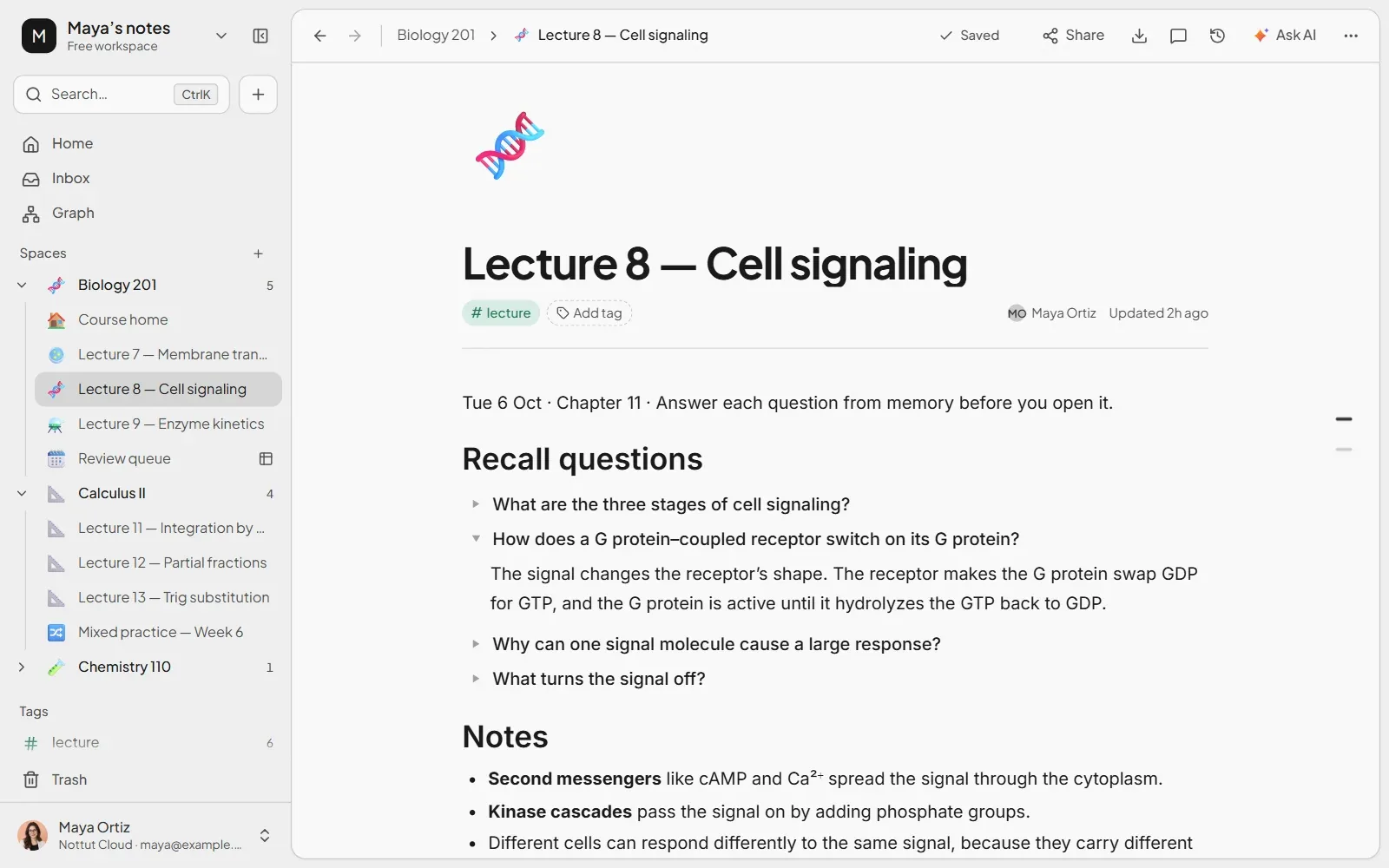
Practice testing: hide the answers. Type /toggle, write a question as the toggle's title and put the answer inside, so it stays hidden until you have tried. The Cornell notes template does the same with a cue column of questions next to the notes.
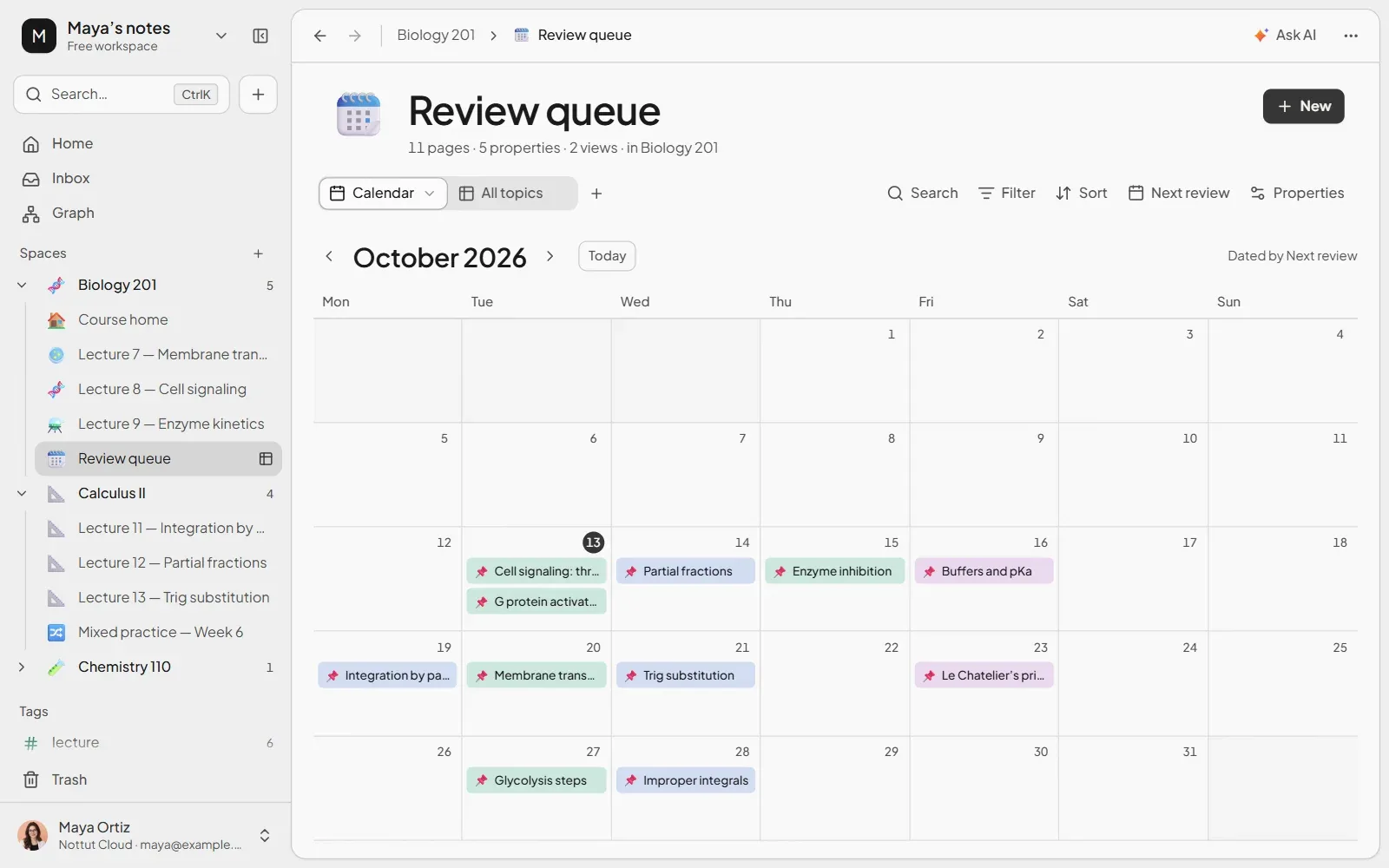
Spaced practice: give each topic a next review date. Click Database on Home to create one, add a row per topic and a Next review date property, and add a Calendar view to see what is due. When you review a topic, move its date further out.
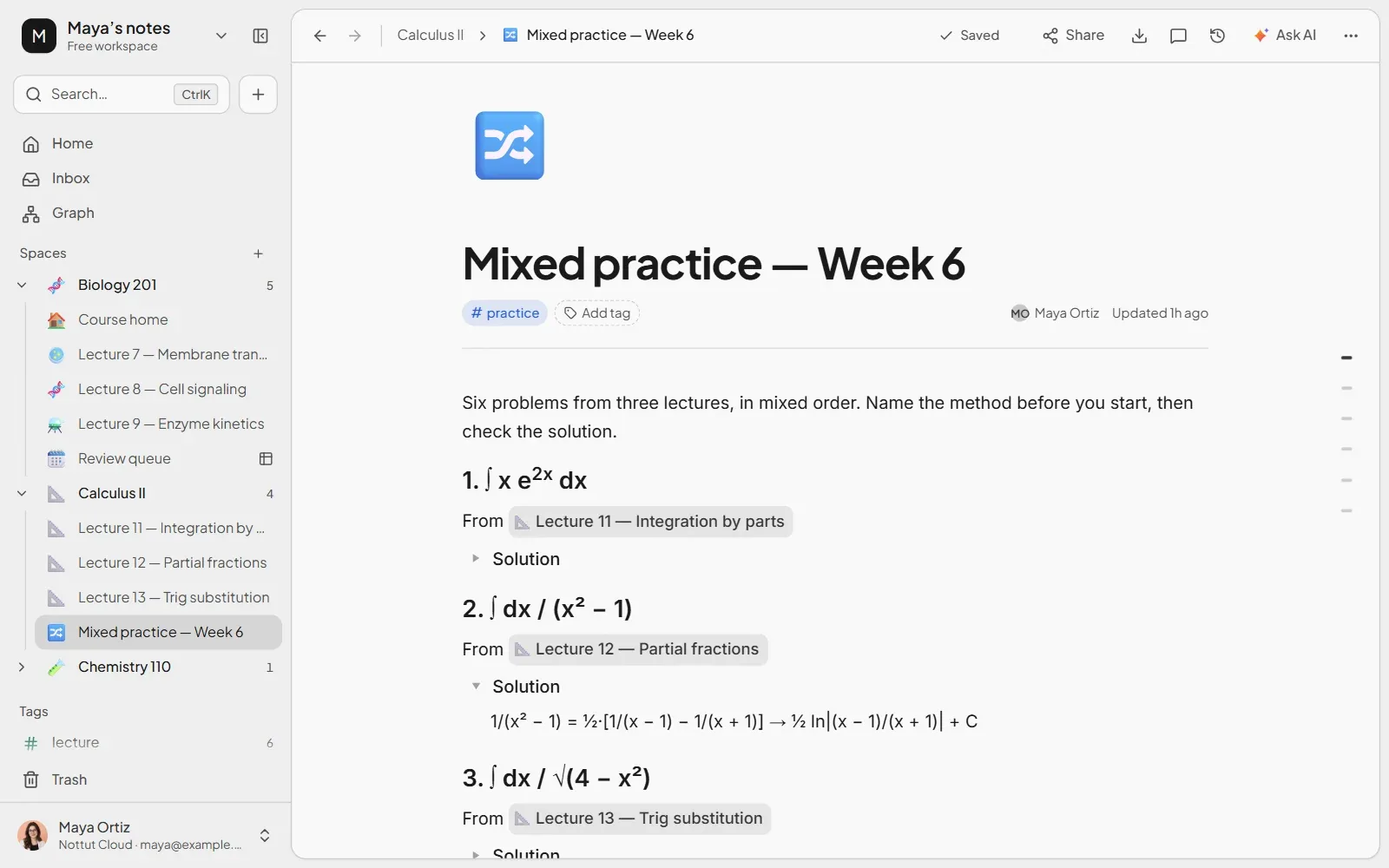
Interleaving: keep a mixed practice page. Each week, copy problems from several lectures onto one page, in mixed order, with worked solutions hidden in toggles. Link each problem back to its lecture with [[, so a problem you miss sends you to the right notes.
Self-explanation: write the why. Under each key idea, add a callout with a "Why is this true?" question and answer it in your own words. If you use AI, use it afterwards: select your explanation, open the AI menu in the toolbar that appears, and ask it to point out what your explanation missed, instead of letting it explain for you. Reading an AI summary is not the same as summarizing yourself.
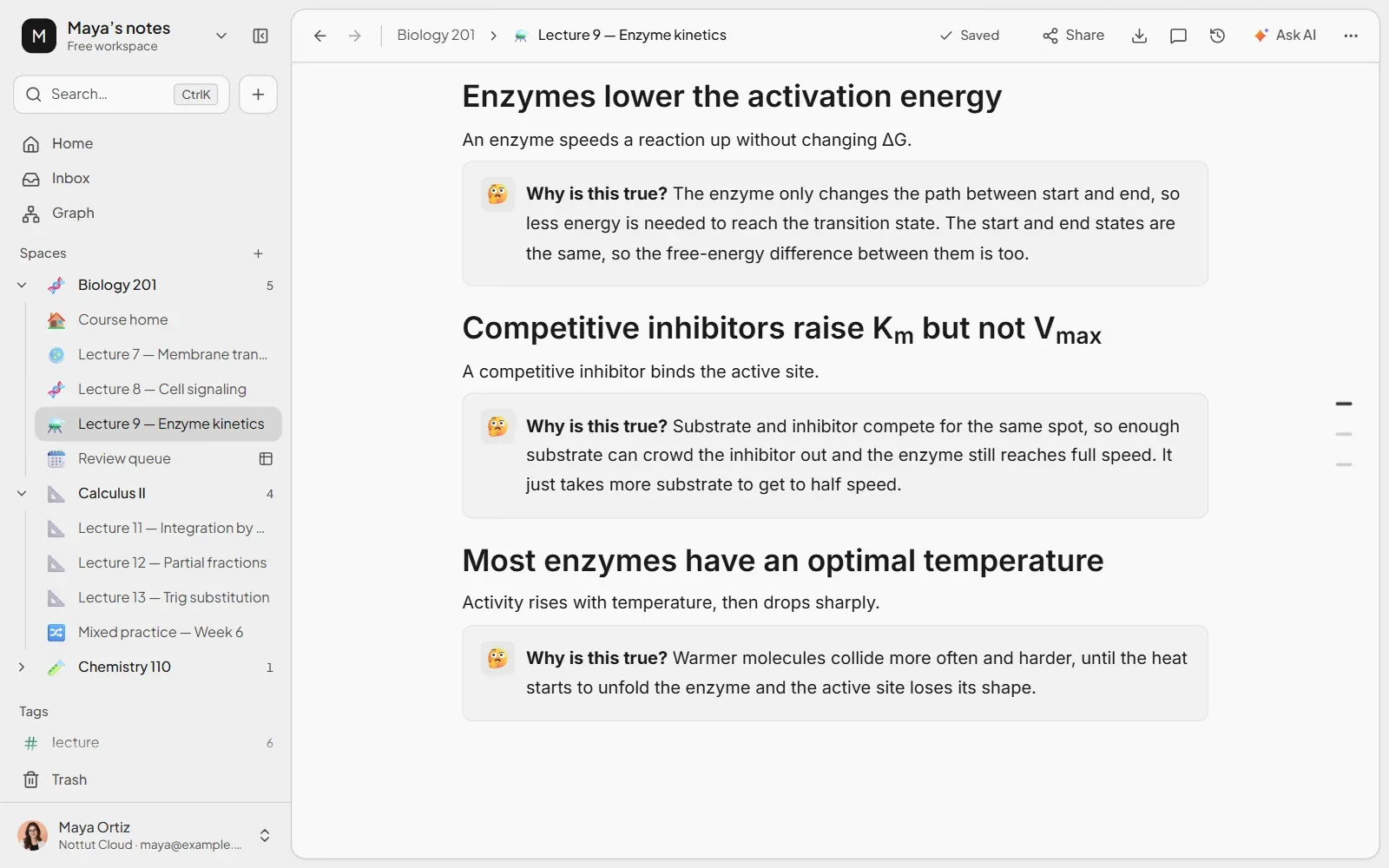
Save the setup as a template. Once a lecture page has your question toggles, why-callouts and a summary, open the ··· menu at the top right and choose Save as template, so every new lecture starts the same way.
FAQ
What is the most effective study technique?
Practice testing and spaced practice have the strongest and most general evidence. Answering questions from memory, checking your answers, and spreading that over several days beats rereading the same material for the same amount of time.
Is the Pomodoro technique evidence-based?
Not for learning. Three small trials compared fixed Pomodoro-style breaks with breaks students chose themselves and found no difference in how much they learned or got done. The timer can help you start; what you do in the 25 minutes matters more.
Does the Feynman technique work?
Its parts do. Explaining ideas in your own words (self-explanation) and studying as if you'll have to teach both have solid evidence. The named four-step method has been tested directly in only one small study.
Is highlighting a good study technique?
On its own, not much. It is rated low, and most students highlight too much. Read the section first, highlight only the main points, and then turn them into questions you answer from memory.
Is rereading a waste of time?
No, but it is one of the least effective uses of study time. It helps most when the rereading is spaced out and you test yourself between readings.
Are flashcards active recall?
Yes, if you answer before flipping the card. Keep each card in rotation until you have recalled it correctly at least three times; students who drop cards after one correct answer remember much less.
Is blurting active recall?
Yes. Writing everything you remember on a blank page is free recall, and in one study it beat drawing a concept map with the text open.
What are the best study techniques for visual learners?
The same as for everyone else. There is no good evidence that matching study techniques to a learning style improves learning. Use visuals when the material is visual, like anatomy, maps or diagrams, and combine them with practice testing.
Should I study one subject at a time or switch between them?
For practice problems, mix types within a subject once you have learned each one; it feels harder but works better on later tests. Spread each subject over several days rather than one long session.
The short version
Test yourself from memory, check the answers, and spread that over days. Mix problem types once you know each one, and ask "why?" about what you read. Use rereading, highlighting and summaries only as a way into those. If you want the whole routine in one place, try Nottut free: question toggles, review calendars, linked lecture notes and templates.
Related reading: Active recall and spaced repetition · How to take better notes · Free Cornell notes template
Sources
- Bisra, K., Liu, Q., Nesbit, J. C., Salimi, F., & Winne, P. H. (2018). Inducing self-explanation: A meta-analysis. Educational Psychology Review, 30(3), 703–725. doi:10.1007/s10648-018-9434-x
- Biwer, F., Wiradhany, W., oude Egbrink, M. G. A., & de Bruin, A. B. H. (2023). Understanding effort regulation: Comparing 'Pomodoro' breaks and self-regulated breaks. British Journal of Educational Psychology, 93(S2), 353–367. doi:10.1111/bjep.12593
- Bjork, R. A. (1994). Memory and metamemory considerations in the training of human beings. In J. Metcalfe & A. P. Shimamura (Eds.), Metacognition: Knowing about knowing (pp. 185–205). MIT Press.
- Brunmair, M., & Richter, T. (2019). Similarity matters: A meta-analysis of interleaved learning and its moderators. Psychological Bulletin, 145(11), 1029–1052. doi:10.1037/bul0000209
- Cepeda, N. J., Pashler, H., Vul, E., Wixted, J. T., & Rohrer, D. (2006). Distributed practice in verbal recall tasks: A review and quantitative synthesis. Psychological Bulletin, 132(3), 354–380. doi:10.1037/0033-2909.132.3.354
- Cepeda, N. J., Vul, E., Rohrer, D., Wixted, J. T., & Pashler, H. (2008). Spacing effects in learning: A temporal ridgeline of optimal retention. Psychological Science, 19(11), 1095–1102. doi:10.1111/j.1467-9280.2008.02209.x
- Donoghue, G. M., & Hattie, J. A. C. (2021). A meta-analysis of ten learning techniques. Frontiers in Education, 6, 581216. doi:10.3389/feduc.2021.581216
- Dunlosky, J., Rawson, K. A., Marsh, E. J., Nathan, M. J., & Willingham, D. T. (2013). Improving students' learning with effective learning techniques: Promising directions from cognitive and educational psychology. Psychological Science in the Public Interest, 14(1), 4–58. doi:10.1177/1529100612453266
- Farrand, P., Hussain, F., & Hennessy, E. (2002). The efficacy of the "mind map" study technique. Medical Education, 36(5), 426–431. doi:10.1046/j.1365-2923.2002.01205.x
- Göksu, A., Wiradhany, W., & de Bruin, A. B. H. (2026). When to take a break: Comparing effects of systematic short (Pomodoro) and self-regulated breaks on subjective experience and actual learning. Behavioral Sciences, 16(7), 1158. doi:10.3390/bs16071158
- Hartwig, M. K., & Dunlosky, J. (2012). Study strategies of college students: Are self-testing and scheduling related to achievement? Psychonomic Bulletin & Review, 19(1), 126–134. doi:10.3758/s13423-011-0181-y
- Karpicke, J. D., & Blunt, J. R. (2011). Retrieval practice produces more learning than elaborative studying with concept mapping. Science, 331(6018), 772–775. doi:10.1126/science.1199327
- Karpicke, J. D., Butler, A. C., & Roediger, H. L., III. (2009). Metacognitive strategies in student learning: Do students practise retrieval when they study on their own? Memory, 17(4), 471–479. doi:10.1080/09658210802647009
- Karpicke, J. D., & Roediger, H. L., III. (2008). The critical importance of retrieval for learning. Science, 319(5865), 966–968. doi:10.1126/science.1152408
- Kobayashi, K. (2024). Interactive learning effects of preparing to teach and teaching: A meta-analytic approach. Educational Psychology Review, 36(1), Article 26. doi:10.1007/s10648-024-09871-4
- Kornell, N., & Bjork, R. A. (2007). The promise and perils of self-regulated study. Psychonomic Bulletin & Review, 14(2), 219–224. doi:10.3758/BF03194055
- Latimier, A., Peyre, H., & Ramus, F. (2021). A meta-analytic review of the benefit of spacing out retrieval practice episodes on retention. Educational Psychology Review, 33, 959–987. doi:10.1007/s10648-020-09572-8
- Miyatsu, T., Nguyen, K., & McDaniel, M. A. (2018). Five popular study strategies: Their pitfalls and optimal implementations. Perspectives on Psychological Science, 13(3), 390–407. doi:10.1177/1745691617710510
- Pashler, H., McDaniel, M., Rohrer, D., & Bjork, R. (2008). Learning styles: Concepts and evidence. Psychological Science in the Public Interest, 9(3), 105–119. doi:10.1111/j.1539-6053.2009.01038.x
- Reyes, E. P., Blanco, R. M. F. L., Doroon, D. R. L., Limana, J. L. B., & Torcende, A. M. A. (2021). Feynman technique as a heutagogical learning strategy for independent and remote learning. Recoletos Multidisciplinary Research Journal, 9(2), 1–13. doi:10.32871/rmrj2109.02.06
- Roediger, H. L., III, & Karpicke, J. D. (2006). Test-enhanced learning: Taking memory tests improves long-term retention. Psychological Science, 17(3), 249–255. doi:10.1111/j.1467-9280.2006.01693.x
- Rohrer, D., Dedrick, R. F., & Burgess, K. (2014). The benefit of interleaved mathematics practice is not limited to superficially similar kinds of problems. Psychonomic Bulletin & Review, 21(5), 1323–1330. doi:10.3758/s13423-014-0588-3
- Rohrer, D., Dedrick, R. F., & Stershic, S. (2015). Interleaved practice improves mathematics learning. Journal of Educational Psychology, 107(3), 900–908. doi:10.1037/edu0000001
- Rohrer, D., & Taylor, K. (2007). The shuffling of mathematics problems improves learning. Instructional Science, 35, 481–498. doi:10.1007/s11251-007-9015-8
- Rowland, C. A. (2014). The effect of testing versus restudy on retention: A meta-analytic review of the testing effect. Psychological Bulletin, 140(6), 1432–1463. doi:10.1037/a0037559
- Smits, E. J. C., Wenzel, N., & de Bruin, A. (2025). Investigating the effectiveness of self-regulated, Pomodoro, and Flowtime break-taking techniques among students. Behavioral Sciences, 15(7), 861. doi:10.3390/bs15070861
- Yang, C., Luo, L., Vadillo, M. A., Yu, R., & Shanks, D. R. (2021). Testing (quizzing) boosts classroom learning: A systematic and meta-analytic review. Psychological Bulletin, 147(4), 399–435. doi:10.1037/bul0000309